
Abstract
Aim:
We aimed to compare the sociodemographic and clinical variables of the patients with bipolar disorder (BD), who were required guardianship by Mental Health Hospital’s Health Board.
Materials and Methods:
This retrospective study consisted of 201 patients with BD-1, aged between 18 and 65 years, who were sent to medical health board in order to prepare a report on whether guardianship was required by the courts. Sociodemographic and clinical variables data form including age, marital status, education, employment, the number of episodes, the history of electroconvulsive therapy (ECT), the type of medication, the number of hospitalization, and the history of suicide were used.
Results:
One-hundred (49.75%) patients with BD were required guardianship decision (GD). The mean age of the group with GD (43.57±11.53 years) was significantly higher than the group without GD (39.54±10.73 years). There was a significant relationship between GD and marital status and employment. The group with GD had significantly higher number of total and manic episodes, duration of hospitalization, and duration of illness than the group without GD. A significant relationship was found between GD and medical comorbidity, history of ECT, the presence of psychotic Manndelusion, and treatment with antipsychotic, lithium and valproic acid. Paranoid-persecution, reference, and bizarre types of delusion were found to be related to GD.
Conclusion:
A significant relationship was found between GD and marital status, employment, duration of illness, number and duration of hospitalizations, number of total and manic episodes, medical comorbidity, and history of ECT, presence of psychotic delusions, and type of treatment. Clinicians should be aware of these variables during the decision of guardianship for patients with BD.
Keywords: Bipolar disorder, guardianship, restriction
INTRODUCTION
The Civil Code (CC) defines the conditions for a person’s entitlement to and exercise of the rights, as well as guarantees those rights in cases where those rights are obstructed or restricted. From the civil rights point of view, while the competence of the person is prioritized, the rights are kept at the highest level and the least restrictions are imposed on the person1. “Capacity to act” provides a legal consequence to human actions. According to the CC, the capacity to act is defined as the ability to act rationally and to comprehend the causes and consequences of their actions. Capacity to act is a mental function such as understanding, discerning, reasoning, making decisions, and reaching conclusions. Evaluation of capacity to act should be specific to the person, situation, and event1,2.
Courts restrict the civil rights of people and transfer their obligation to exercise their rights to their legal representative, thereby putting such a person under guardianship. Guardianship is defined as “an institution that protects adults who are incapable of self-management for some reason, in terms of personal and financial interests, and ensures their representation”3. CC art. 405 governs the total deprivation of a person’s civil rights if they have a mental illness or weakness. Legal consultant is assigned to adults who do not have sufficient reasons to be restricted, but who benefit from the limitation of their capacity to act in some respects4. With the concept of guardianship, it is aimed to attach a legal consequence to the actions of the person and to protect herself and the society from the consequences of the actions of the person who has no capacity to act. Treatment and protection of civil rights of patients who are placed under guardianship in psychiatry clinics are provided through courts5. Guardianship may be essential for the patients with psychiatric disorders, such as schizophrenia, bipolar disorder, and developmental disorder, due to their lack of decision-making capacity. It is appropriate to recommend guardianship to those who have insufficient insight, frequent episodes, and those who do not respond to treatment or have a severe disease that will make their daily life difficult1,6. Melamed et al.7 investigated guardianship of 60 people with a mental disorder in Israel. According to the results of this study, the majority of the patients with guardianship decisions (GD) were psychotic disorders and dementia while 1% of them included patients with BD. According to a previous study that investigated guardianship reports given by mental health hospital’s medical board in Turkey, 31% of those individuals had dementia, 28% of them had a psychotic disorder, 15.2% of them had mental retardation and 8.1% of them had BD8. Although a GD is rare for patients with BD than other chronic psychiatric disorders, BD is one of the important psychiatric illnesses that require a GD. It is considered to offer guardianship to patients with BD who have insufficient insight, become chronic, do not respond to treatment, and have a severe illness that will make their daily life difficult7. Recently, Akıncı et al.9 investigated clinical and sociodemographic characteristics of patients with BD with the decision of a legal representative. According to this study, the total number of episodes, number of manic and mixed episodes, hospitalizations, presence of psychotic symptoms, and alcohol and substance use were found higher in the group with the GD than in the group without GD.
There are few studies on the need for guardianship in the literature, and they generally focus on patients with dementia. There are limited data for the GD of patients with BD. In this study, we aimed to compare the sociodemographic and clinical variables of the patients with BD according to their GD which was given by Mental Health Hospital’s Health Board.
GİRİŞ
Medeni Kanun (MK), kişinin haklara sahip olması ve bu hakları kullanmasına ilişkin koşulları tanımladığı gibi, bu hakların engellendiği veya kısıtlandığı durumlarda da bu hakları güvence altına almaktadır. Medeni haklar açısından bakıldığında kişinin yetkinliği ön planda tutulurken, haklar en üst seviyede tutulmakta ve kişiye en düşük seviyede kısıtlama getirilmektedir1. “Fiil ehliyeti” insan eylemlerine hukuki bir sonuç sağlamaktadır. MK’ya göre fiil ehliyeti, akılcı hareket edebilme ve eylemlerinin nedenlerini ve sonuçlarını kavrayabilme yeteneği olarak tanımlanmaktadır ve anlama, ayırt etme, akıl yürütme, karar verme ve sonuca varma gibi zihinsel bir işlevdir. Fiil ehliyetinin değerlendirilmesi kişiye, duruma ve olaya özgü olmalıdır1,2.
Mahkemeler kişilerin medeni haklarını kısıtlayarak ve haklarını kullanma yükümlülüğünü yasal temsilcisine devrederek bu kişileri vesayet altına almaktadır. Vesayet, “herhangi bir nedenle kendi kendini yönetemeyen yetişkinleri, kişisel ve mali çıkarları açısından koruyan ve temsilini sağlayan kurum” olarak tanımlanmaktadır3. MK madde 405, akıl hastalığı veya zayıflığı bulunan bir kişinin medeni haklarından tamamen yoksun bırakılmasını düzenlemektedir. Kısıtlanmak için yeterli gerekçeleri bulunmayan ancak bazı açılardan fiil ehliyetinin kısıtlanmasından yararlanan yetişkinlere hukuk danışmanı atanır4. Vesayet kavramı ile kişinin eylemlerine hukuki bir sonuç yüklenmesi ve fiil ehliyeti bulunmayan kişinin eylemlerinin sonuçlarından kendisinin ve toplumun korunması amaçlanmaktadır. Psikiyatri kliniklerinde vesayet altına alınan hastaların tedavisi ve medeni haklarının korunması mahkemeler aracılığıyla sağlanmaktadır5. Şizofreni, bipolar bozukluk (BB) ve gelişimsel bozukluk gibi psikiyatrik bozuklukları olan hastaların karar verme kapasitelerinin olmaması nedeniyle vesayet gerekli olabilir. İçgörüsü yetersiz olan, sık atak geçiren, tedaviye yanıt vermeyen veya günlük yaşamını zorlaştıracak ciddi hastalığı olan kişilere vesayet verilmesinin önerilmesi uygundur1,6. Melamed ve ark.7 İsrail’de ruhsal bozukluğu olan 60 kişinin vesayetini araştırmıştır. Bu çalışmanın sonuçlarına göre vesayet kararı (VK) verilen hastaların çoğunluğunu psikotik bozukluklar ve demans, %1’ini ise BB hastaları oluşturmaktadır. Türkiye’de ruh sağlığı hastaneleri sağlık kurulu tarafından verilen vesayet raporlarının incelendiği daha önce yapılan bir araştırmaya göre, bu kişilerin %31’inde demans, %28’inde psikotik bozukluk, %15,2’sinde zeka geriliği ve %8,1’inde BB olduğu belirlenmiştir. BB hastalarında VK diğer kronik psikiyatrik bozukluklara göre nadir olmakla birlikte, BB VK gerektiren önemli psikiyatrik hastalıklardan biridir. İçgörüsü yetersiz olan, kronikleşen, tedaviye yanıt vermeyen ve günlük yaşamını zorlaştıracak ağır hastalığı olan BB hastalarına vesayet verilmesi düşünülmektedir7. Son zamanlarda Akıncı ve ark.9 yasal temsilci kararı alınmış olan BB hastalarının klinik ve sosyodemografik özelliklerini araştırmışlardır. Bu çalışmaya göre VK’li grupta toplam atak sayısı, manik ve karma atak sayısı, hastaneye yatış, psikotik belirtilerin varlığı ve alkol ve madde kullanımı VK olmayan gruba göre daha yüksek bulunmuştur.
Literatürde vesayet ihtiyacına ilişkin az sayıda çalışma bulunmaktadır ve bunlar genellikle demans hastalarına odaklanmaktadır. BB hastalarının VK’larına ilişkin sınırlı veri bulunmaktadır. Bu çalışmada BB hastalarının sosyodemografik ve klinik değişkenlerinin Ruh Sağlığı Hastanesi Sağlık Kurulu tarafından verilen VK’larına göre karşılaştırılması amaçlanmıştır.
MATERIALS AND METHODS
In this retrospective study, we evaluated the digital medical records of patients with BD, who were sent to medical health board of Erenköy Research and Training hospital for Psychiatry and Neurological disease between 01/01/2015 and 12/31/2021 in order to prepare a report on whether guardianship was required by the courts. Patients with a diagnosis of BD according to Diagnostic and Statistical Manual of Mental Disorder-5 and aged between 18 and 65 years were included. Patients with mental retardation and those with missing files were excluded from the study. Finally, 201 patients with BD were included in the study. Sociodemographic and clinical data form including history of disease, number of episodes, history of ECT, type of medication, number of hospitalization, history of suicide were used. Approval for the study was granted by the Erenköy Research and Training Hospital for Mental Health and Neurological Diseases Ethical Committee with approval number 34, dated October 04, 2021.
Statistical Analysis
The data were analyzed using the Statistical Package for the Social Sciences 22 program. A frequency table was created for sociodemographic questions. In order to see the differences in the group means of the decision variable, independent sample t-test was applied for the measurement values with normal distribution, and the Mann-Whitney U analysis was applied for the measurement values that did not show normal distribution. Chi-square analysis was performed to see the relationship between the decision variable and the categorical variables. A p value less than 0.05 was considered as significant.
RESULTS
A total of 201 participants were included in our study. Among all of the participants, 100 patients with BD required GD and 101 patients with BD did not require GD. A comparison of the sociodemographic characteristics of the participants with GD and without GD was shown in . The mean age of the group with GD was 43.57±11.53 years and the mean age of group without GD was 39.54±10.73 years. It was determined that the group with (GD) had a higher age (t=-2.562, p=0.011) than the group without GD.
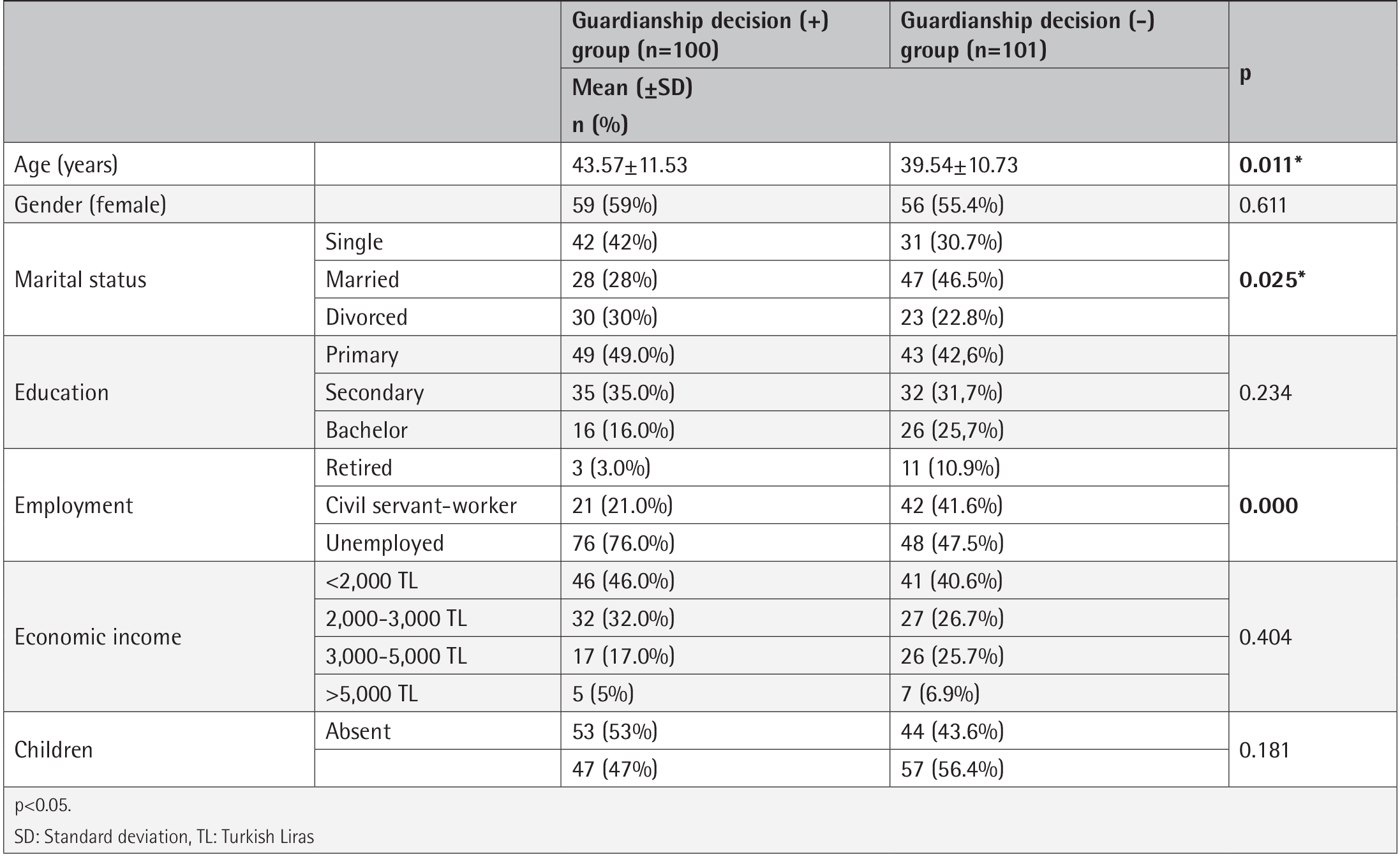
There was a significant relationship between GD and marital status (x2=7.391, p=0.025) and employment (x2=17.889, p=0.000). Of the patients with GD, 42% were single, 28% were married, and 30% were divorced. Of the patients without GD, 30.7% were single, 46.5% were married, and 22.8% were divorced. Of the group with GD, 76% were unemployed, 20% were workers, and 3% were retired. On the other hand, of the group without GD, 47.5% were unemployed, 41.6% were working, and 10.9% were retired. No relationship was found between GD and economic income (x2=2.923, p=0.404), gender (x2=0.259, p=0.611), education level (x2=2.902, p=0.234), and the presence of children (x2=1.792, p=0.181).
Comparison results of clinical variables for two groups were presented in . There was no significant difference between two groups in terms of age of onset (z=-0.058, p=0.954) and number of depressive episodes (z=-0.969, p=0.332). However, there were significant differences between two groups in terms of duration of illness (z=-2.433, p=0.016), number of total episodes (z=-3.919, p=0.000), number of manic episodes (z=-4.048, p=0.000), and duration of hospitalization (z=-5.838, p=0.000).
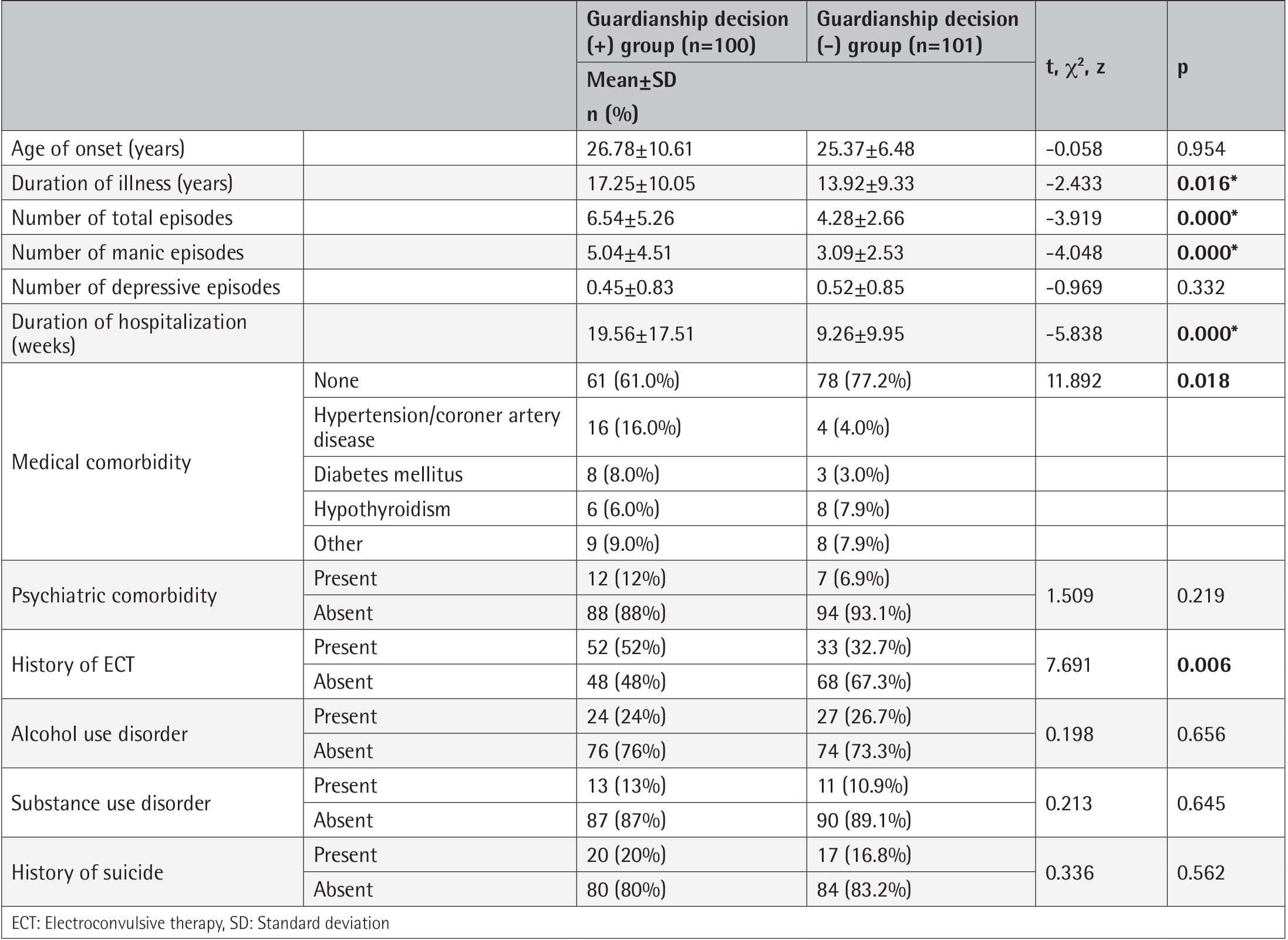
22.8% of those who did not require GD had no medical comorbidity and 39% of those who required GD had medical comorbidity. A significant relationship was found between GD and medical comorbidity (x2=11.892, p=0.018). 12% of those with GD had psychiatric comorbidity and 7% of those without GD had psychiatric comorbidity. No significant relationship was found between GD and psychiatric comorbidity (x2=1.509, p=0.219). A significant relationship was found between the history of ECT (x2=7.691, p=0.006) and GD. While 52% of those with GD had a history of ECT, 32.7% of those that did not require GD had a history of ECT. No significant relationship was found between GD and alcohol use disorder (x2=0.198, p=0.656), substance use disorder (x2=0.213, p=0.645), and the history of suicide (x2=0.336, p=0.562).
The comparison of the delusion types and drugs used by patients in the decision of guardianship was shown in . There was a significant relationship between psychotic delusion and decision of guardianship (x2=23.565, p=0.000). While 39.6% of those who did not take GD did not have psychotic delusions, 60.4% of them had psychotic delusions. 10% of the patients with GD did not have psychotic delusions and 90% of them had psychotic delusions. A significant relationship was found between the decision of guardianship and paranoid-persecution type of delusion (x2=10.321, p=0.001), delusion of reference (x2=6.065, p=0.014), and bizarre delusion (x2=4.787, p=0.029). No significant relationship was found between the decision of guardianship and grandiose delusion (x2=2.441, p=0.118) and mystical delusion (x2=0.107, p=0.744).
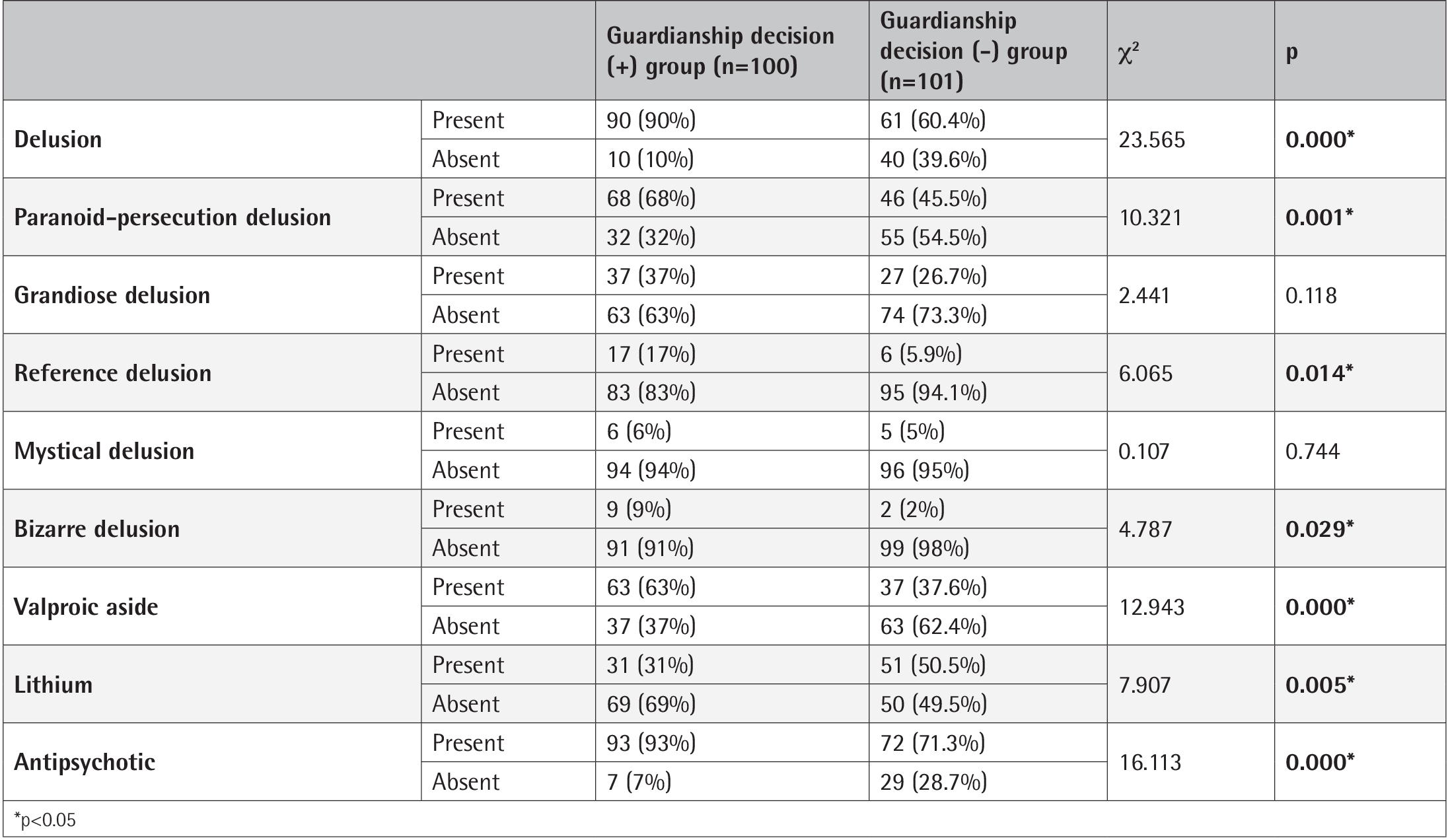
When it comes to drug used by the patients, a significant relationship was found between valproic acid (VPA) and the decision of guardianship (x2=12.943, p=0.000). 37.6% of those who did not take a GD used VPA whereas 63% of those who required GD used VPA. A significant relationship was found between lithium and the decision of guardianship (x2=7.907, p=0.005). 69% of those who required GD did not use lithium whereas 49.5% of those who did not require GD did not use lithium. A significant relationship was detected between antipsychotic and the decision of guardianship (x2=16.113, p=0.000). 71.3% of those who did not require GD used antipsychotic and 93% of those who required GD used antipsychotic medication.
DISCUSSION
In this retrospective study, we evaluated medical records of 201 patients with BD, who were sent to medical board by the courts in order to prepare a report on whether legal representative was required. According to our results 100 patients (49.75%) with BD had been required the decision of guardianship. In our study, the mean age of the group with GD was 43.57±11.53 years, the mean of the duration of the illness was 17.25±10.05 years, and both of them were significantly higher than in the group without GD. Our results supported the results of previous study. According to a study in Israel, the mean age of the patients with mental disorder who required guardianship was 48 years and the duration of their illness was 20 years. However, 80% of patients who required guardian were schizophrenia, 5% of them were dementia, and only 1% of them were BD7. In a recent study that investigated the legal representative reports in Türkiye, the mean duration of illness and the mean age of all patients were reported to be 11.8 years and 55 years, respectively. Moreover, it was determined that 39.2% of those patients were dementia, 27.7% of them were schizophrenia and other psychotic disorders, and 4% of them were BD8. Similar to our study, Akıncı et al.9 found that the mean age of patients with BD who required legal representative was 45.8 years. These results can suggest that longer disease duration increases the decision of guardianship.
According to our results, marital status and employment were found to be related to GD. Of the patients with GD, 28% were married, 30% were divorced, and 42% were single. Similar to our results, it has been reported that divorcement is common among people with mental disorder, and divorce and separation are two to three times more probable in people with BD than in general population10. Our results support the idea that BD is associated with higher divorce rate and poor marital adjustment. However, poor marital adjustment can lead to relapses and worse prognosis in BD and this may be related to the higher rates of GD in our study. However, similar to our results, a recent study that investigated 61 adult patients with GD showed that 37% of the patient group were single whereas only 9% of this group were married. This result can be interpreted as GD can lead to poor social support11.
Of the group with GD, 76% were unemployed. According to a meta-analysis, BD damages employment outcome in the longer term, but up to 60% of people may be in employment12. According to our results, of the group without GD, 47.5% were unemployed, which was lower than in the group with GD. The magnitude of functional losses associated with bipolar disorder is large. In the light of our results, the lower functionality indicates unemployment and this may be also related to the need for guardianship in the patients with BD. One of our study’s results was that there was no relationship between GD and economic income, gender, education level, and the presence of children. Akıncı et al.9 found no difference among sociodemographic variables such as gender, educational status, marital status, employment, and social income concerning the recommendations for the requirement of legal representative.
In our study, we found no significant difference between two groups in terms of age of onset, and depressive episodes. However, the number of manic episodes, duration of illness, and duration of hospitalization were higher in the group with GD. It has been reported that periods of relapse lead to progressive dysfunctions, and higher number of episodes was linked with poor prognosis in BD. Moreover, the number of episodes increases the number of hospitalizations as well. Previously, Akıncı et al.9 found significantly greater number of manic and mixed episodes and higher duration of hospitalization in BD patients who were recommended for a guardian. Previous researches also reported a high number of episodes and their high recurrence rate to be important for the restriction decision1,5,13.
The present study found that the presence of medical comorbidity was related to GD. 39% of those that required GD had medical comorbidity in our study. Among those patients, 16% of them had hypertension/coroner artery disease, 8% of them had diabetes mellitus, 6% of them had hypothyroidism. According to a recent review, BD is associated with chronic low-grade inflammation and several medical comorbidities such as cardiovascular disease, diabetes mellitus, and obesity in patients with BD14. However, metabolic illness and obesity are related to greater symptom severity and poor treatment responses. Thus, a decreased life expectancy is seen in BD14. We can interpret these results in the way that medical comorbidity is related to poor prognosis in BD and poor prognosis is related to higher rates of requirement of guardianship in those patients.
It is critical to consider coexisting psychiatric disorders when deciding whether to appoint a guardian in patients with BD. According to our study, 12% of those with GD had psychiatric comorbidity and 7% of those without GD had psychiatric comorbidity. Moreover, no significant relationship was found between GD and psychiatric comorbidity, alcohol and substance use disorder. Vieta et al.15 reported that the rate of psychiatric comorbidity in BD was 31% and psychiatric comorbidity affected the treatment response and prognosis in a negative way. Alcohol and substance use disorder is a common comorbidity for BD. Contrary to the results of our study, Akıncı et al.9 found higher rates of alcohol and substance use disorder in the patients with BD who required guardian and the presence of psychiatric comorbidity increased the likelihood of assigning a guardian 11-fold. The difference in the results of our study and Akıncı et al.’s9 study may be explained by the retrospective design of our study. We could not make an interview with the patients and data of the patients may have been lost due to its retrospective design.
The psychotic features of the last episodes of the patients were listed in . According to our results, 90% of the patients with GD had psychotic delusion in the last episode of their hospitalization, and it was found to be related to the decision of guardianship. In BD, the presence of a psychotic symptoms indicates a poor prognosis and lower functionality16. According to our results, there was a relationship between the decision of guardianship and paranoid-persecution, reference, and bizarre types of delusion. No relationship was demonstrated between mystical and grandiose types of delusion. A recent study showed that a lifetime history of psychotic symptoms was present in 73.8% of patients with BD and delusions were seen in 68.9% of those patients. However, patients with psychotic symptoms showed younger age of disease onset and higher number of hospitalizations with manic episodes17. Thus, we can say that psychotic features in BD may affect the restriction decision, and our study also supports the literature in this respect.
We found a significant relationship between GD-lithium treatment and GD-VPA treatment. According to our results, 69% of the patients who required guardianship did not use lithium whereas 63% of them used VPA. Previous studies showed that treatment with lithium lowers the risk of relapse in BD. According to a meta-analysis, long-term lithium treatment has been suggested due to the chronic persistent impairment secondary to relapses. Thus, long-term lithium treatment should be started earlier rather than later18. In this present study, the majority of the patients with GD did not use lithium. We can interpret these results as the patients who required GD relapsed more frequently by using less lithium and adversely affected the prognose in this way.
Study Limitations
This study has certain strengths and limitations. One of the important strengths of our study is that there are very rare researches on the GD for psychiatric disorders, especially bipolar disorder. Our hospital is a mental health hospital and the medical board is specialized for forensic psychiatry. Thus, we think that the participants of our study guide in terms of bipolar population in Turkey. One of the limitations is the study’s retrospective design. The assessment of the patients was done by scanning the hospital files. We could not evaluate the patients face to face. Second, our sample size was relatively small. Prospective studies are needed to examine many variables in the process of GD.
TARTIŞMA
Bu retrospektif çalışmada, yasal temsilci gerekip gerekmediğine ilişkin rapor hazırlanması amacıyla mahkemeler tarafından sağlık kuruluna gönderilen 201 BB hastasının tıbbi kayıtları değerlendirildi. Sonuçlarımıza göre 100 BB hastasının (%49,75) VK’ye ihtiyacı vardı. Çalışmamızda VK’li grubun yaş ortalaması 43,57±11,53 yıl, hastalık süresi ortalaması 17,25±10,05 yıl olup her ikisi de VK olmayan gruba göre anlamlı derecede yüksekti. Sonuçlarımız daha önce yapılan çalışmanın sonuçlarını destekledi. İsrail’de yapılan bir araştırmaya göre vesayet gerektiren ruhsal bozukluğu olan hastaların ortalama yaşı 48, hastalık süresi ise 20 yıldı. Ancak vesayet gerektiren hastaların %80’i şizofreni, %5’i demans ve sadece %1’i BBidi7. Türkiye’deki yasal temsilci raporlarının incelendiği yakın tarihli bir çalışmada ise tüm hastaların ortalama hastalık süresi 11,8 yıl ve ortalama yaşı 55 yıl olarak bildirilmiştir. Ayrıca bu hastaların %39,2’sinin demans, %27,7’sinin şizofreni ve diğer psikotik bozukluklar, %4’ünün ise BBolduğu belirlenmiştir8. Çalışmamıza benzer şekilde Akıncı ve ark.9 yasal temsilciye ihtiyaç duyan BB hastalarının yaş ortalamasının 45,8 yıl olduğunu bulmuşlardır. Bu sonuçlar, hastalık süresinin uzamasının VK’yi artırdığını düşündürebilir.
Sonuçlarımıza göre medeni durum ve istihdamın VK ile ilişkili olduğu tespit edildi. VK’li hastaların %28’i evli, %30’u boşanmış, %42’si bekardı. Sonuçlarımıza benzer şekilde ruhsal bozukluğu olan kişilerde boşanmanın yaygın olduğu ve BB hastalarında boşanma ve ayrılma olasılığının genel nüfusa göre iki ila üç kat daha fazla olduğu rapor edilmiştir10. Sonuçlarımız BB’nin yüksek boşanma oranı ve zayıf evlilik uyumu ile ilişkili olduğu fikrini desteklemektedir. Ancak zayıf evlilik uyumu BB’de nükslere ve kötü prognoza neden olabilir ve bu durum çalışmamızda VK oranlarının daha yüksek olmasıyla ilişkili olabilir. Ancak bizim sonuçlarımıza benzer şekilde, VK’li 61 yetişkin hastanın incelendiği güncel bir çalışmada hasta grubunun %37’sinin bekar olduğu, bu grubun ise yalnızca %9’unun evli olduğu gösterilmiştir. Bu sonuç, VK’nin zayıf sosyal desteğe yol açabileceği şeklinde yorumlanabilir11.
VK’li grubun %76’sı işsizdi. Bir meta-analize göre BB uzun vadede iş durumuna olumsuz etkide bulunmaktadır, ancak insanların %60’a kadarı çalışıyor olabilir12.Sonuçlarımıza göre VK’siz grubun %47,5’i işsizdi ve bu oran VK’li gruba göre daha düşüktü. BB ile ilişkili fonksiyonel kayıpların boyutu büyüktür. Sonuçlarımız ışığında işlevselliğin düşük olması işsizliğe işaret etmektedir ve bu durum BB hastalarında vesayet ihtiyacı ile de ilişkili olabilir. Çalışmamızın sonuçlarından biri VK ile ekonomik gelir, cinsiyet, eğitim düzeyi ve çocuk varlığı arasında herhangi bir ilişkinin olmamasıydı. Akıncı ve ark.9 yasal temsilci zorunluluğuna ilişkin önerilerinde cinsiyet, eğitim durumu, medeni durum, çalışma durumu ve sosyal gelir gibi sosyodemografik değişkenler arasında bir fark bulamamışlardır.
Çalışmamızda depresif dönemlerin başlangıç yaşı ve depresif dönemler açısından iki grup arasında anlamlı fark bulamadık. Ancak VK’li grupta manik dönem sayısı, hastalık süresi ve hastanede kalış süresi daha yüksekti. Nüks dönemlerinin ilerleyici işlev bozukluklarına yol açtığı ve daha fazla atak sayısının BB’de kötü prognozla bağlantılı olduğu bildirilmektedir. Ayrıca atak sayısı hastaneye yatış sayısını da artırmaktadır. Daha önce Akıncı ve ark.9 vasi tavsiye edilen BB hastalarında anlamlı olarak daha fazla manik ve karma dönem ve daha fazla hastanede kalış süresi saptamışlardır. Daha önce yapılan araştırmalarda da epizot sayısının ve bunların tekrarlama oranının yüksek olmasının kısıtlama kararı açısından önemli olduğu bildirilmiştir1,5,13.
Bu çalışma tıbbi komorbidite varlığının VK ile ilişkili olduğunu bulmuştur. Çalışmamızda VK gerektirenlerin %39’unda tıbbi ek hastalık mevcuttu. Bu hastaların %16’sında hipertansiyon/koroner arter hastalığı, %8’inde diyabet ve %6’sında hipotiroidi vardı. Yakın zamanda yapılan bir incelemeye göre BB, BB’li hastalarda kronik düşük dereceli enflamasyon ve kardiyovasküler hastalık, diyabet ve obezite gibi çeşitli tıbbi komorbiditelerle ilişkilidir14. Bununla birlikte, metabolik hastalık ve obezite, semptomların şiddetinin artması ve tedavi yanıtlarının kötü olmasıyla ilişkilidir. Böylece BB’de yaşam beklentisinin azaldığı görülmektedir14. Bu sonuçları, BB’de tıbbi komorbiditenin kötü prognozla, kötü prognozun ise bu hastalarda daha yüksek oranda vesayet gereksinimiyle ilişkili olduğu şeklinde yorumlayabiliriz. BB hastalarına vasi atanıp atanmayacağına karar verirken eşlik eden psikiyatrik bozuklukların göz önünde bulundurulması önemlidir. Çalışmamıza göre VK olanların %12’sinde psikiyatrik eş hastalık, VK olmayanların ise %7’sinde psikiyatrik eş hastalık mevcuttu. Ayrıca VK ile psikiyatrik ek tanı, alkol ve madde kullanım bozukluğu arasında anlamlı bir ilişki bulunamadı. Vieta ve ark.15 BB’de psikiyatrik komorbidite oranının %31 olduğunu ve psikiyatrik komorbiditenin tedaviye yanıtı ve prognozu olumsuz yönde etkilediğini bildirmişlerdir. Alkol ve madde kullanım bozukluğu BB için sık görülen bir komorbiditedir. Bizim çalışmamızın sonuçlarının aksine Akıncı ve ark.9 vasi gerektiren BB hastalarında alkol ve madde kullanım bozukluğu oranının daha yüksek olduğunu ve psikiyatrik eş hastalık varlığının vasi atanma olasılığını 11 kat artırdığını bulmuşlardır. Bizim çalışmamızın sonuçları ile Akıncı ve ark.’nın9 çalışması arasındaki fark, çalışmamızın retrospektif tasarımıyla açıklanabilir. Retrospektif tasarımı nedeniyle hastalarla görüşme yapamadık ve hastaların verileri kaybolmuş olasılığı bulunmaktadır.
Hastaların son ataklarındaki psikotik özellikler ’te sıralandı. Sonuçlarımıza göre VK’li hastaların %90’ının hastaneye yatışlarının son evresinde psikotik sanrılar yaşadığı ve bunun VK ile ilişkili olduğu tespit edildi. BB’de psikotik belirtilerin varlığı kötü prognoza ve düşük işlevselliğe işaret etmektedir16. Sonuçlarımıza göre VK ile paranoid-perseküsyon, referans ve tuhaf sanrı türleri arasında ilişki vardı. Mistik ve büyüklük sanrı türleri arasında hiçbir ilişki gösterilmemiştir. Yakın zamanda yapılan bir araştırma BB hastalarının %73,8’inde yaşam boyu psikotik semptom öyküsü bulunduğunu ve bu hastaların %68,9’unda sanrıların görüldüğünü göstermiştir. Ancak psikotik belirtileri olan hastaların hastalık başlangıç yaşlarının daha erken olduğu ve manik atakla hastaneye yatış sayılarının daha fazla olduğu görüldü17. Dolayısıyla BB’deki psikotik özelliklerin kısıtlama kararını etkileyebileceğini söyleyebiliriz ve çalışmamız da bu konuda literatürü desteklemektedir.
VK-lityum tedavisi ile VK-VPA tedavisi arasında anlamlı bir ilişki bulduk. Sonuçlarımıza göre vesayet gerektiren hastaların %69’u lityum kullanmazken, %63’ü VPA kullanmaktaydı. Önceki çalışmalar lityum tedavisinin BB’de nüksetme riskini azalttığını göstermişti. Bir meta-analize göre, nüksetmelere sekonder kronik kalıcı bozulma nedeniyle uzun süreli lityum tedavisi önerilmiştir. Bu nedenle uzun süreli lityum tedavisine geç başlamak yerine daha erken başlanmalıdır18. Bu çalışmada VK’li hastaların çoğunluğu lityum kullanmıyordu. Bu sonuçları VK gerektiren hastaların daha az lityum kullanarak daha sık nüks yaşadıkları ve bu şekilde prognozun olumsuz etkilendiği şeklinde yorumlayabiliriz.
Çalışmanın Kısıtlılıkları
Bu çalışmanın bazı güçlü yönleri ve sınırlılıkları bulunmaktadır. Çalışmamızın güçlü yönlerinden biri BB başta olmak üzere psikiyatrik bozukluklarda VK’ye ilişkin çok az sayıda araştırmanın bulunmasıdır. Hastanemiz bir ruh sağlığı hastanesi olup, sağlık kurulumuz adli psikiyatri alanında uzmanlaşmıştır. Bu nedenle çalışmamızın katılımcılarının Türkiye’deki BB nüfus açısından yol gösterici olacağını düşünmekteyiz. Çalışmanın sınırlılıklardan biri retrospektif tasarımıdır. Hastaların değerlendirilmesi hastane dosyaları taranarak yapıldı. Hastaları yüz yüze değerlendiremedik. İkincisi, örneklem büyüklüğümüz nispeten küçüktü. VK sürecinde birçok değişkenin inceleneceği ileriye dönük çalışmalara ihtiyaç vardır.
CONCLUSION
In conclusion, we found a significant relationship between the requirement of guardianship and marital status, employment, duration of illness, number and duration of hospitalizations, number of total and manic episodes, medical comorbidity, and history of ECT, presence of psychotic delusions, and type of treatment. We believe that our study will guide further studies and help clinicians in the examination process regarding the restriction decision of patients with BD.
Footnotes
Ethics
Ethics Committee Approval: Approval for the study was granted by the Erenköy Research and Training Hospital for Mental Health and Neurological Diseases Ethical Committee with approval number 34, dated October 4, 2021.
Informed Consent: Retrospective study.
Peer-review: Externally peer-reviewed.
Authorship Contributions
Surgical and Medical Practices: F.K., F.İ., M.A., H.K., S.Ç., Y.S.F., Concept: F.K., F.İ., Design: F.K., F.İ., Data Collection or Processing: F.K., M.A., H.K., S.Ç., Y.S.F., Analysis or Interpretation: F.K., M.A., H.K., S.Ç., Y.S.F., Literature Search: F.K., F.İ., M.A., H.K., S.Ç., Y.S.F., Writing: F.K., F.İ., M.A., H.K., S.Ç., Y.S.F.
Conflict of Interest: No conflict of interest was declared by the authors.
Financial Disclosure: The authors declared that this study received no financial support.
References
Sercan M: Yurttaşlık Hukukunda (Medeni Hukuk) Adli Psikiyatri. Adli Psikiyatri Uygulama Kılavuzu, Ankara: Türkiye Psikiyatri Derneği, Tuna Matbaacılık, 2007.
Türkcan S: Yeşilbursa D: Adli Psikiyatri. Psikiyatri Temel Kitabı. (Eds Köroğlu E, Güleç C): 937-44. Ankara, Hekim Yayın Birliği, 2007.
Soysal H: Adli Psikiyatri Güncellenmiş Basım, İstanbul, Özgür Yayınları, 2012.
Kaçak N: Yeni İçtihatlarla Türk Medeni Kanunu (2nd ed). Ankara, Seçkin Yayıncılık, 2007.
Özden SY: Adli Psikiyatri, İstanbul, 3P PharmaPublication Planning, 2007.
Duman ÖY, Göka E. Yeni Türk Medeni Yasası ve psikiyatri. Psikiyatri Psikoloji Psikofarmakoloji (3P) Dergisi. 2002;10:25-32.
Melamed Y, Doron I, Shnitt D. Guardianship of people with mental disorders. Soc Sci Med. 2007;65:1118-23.
Gokceimam PS, Sunbul EA, Gokbakan AM, Ozel ME, Kurban RD, Askin R. Bir Psikiyatri Dal Hastanesi Saglik Kuruluna vesayet uygunlugu acisindan gonderilen kisilerin degerlendirilmesi. Anadolu Psikiyatri Derg. 2019;20:627-35.
Akıncı E, Öncü F, Ger C, Sabuncuoğlu M, Kırmızı A, Eradamlar N. Clinical and Sociodemographic Characteristics That Affect the Recommendation for Assignment of A Legal Representative in Patients With Bipolar Disorder. Turk Psikiyatri Derg. 2017;28:144-55.
Rusner M, Carlsson G, Brunt DA, Nyström M. The paradox of being both needed and rejected: the existential meaning of being closely related to a person with bipolar disorder. Issues Ment Health Nurs. 2012;33:200-8.
Marwaha S, Durrani A, Singh S. Employment outcomes in people with bipolar disorder: a systematic review. Acta Psychiatr Scand. 2013;128:179-93.
Ricotta DN, Parris JJ, Parris RS, Sontag DN, Mukamal KJ. The Burden of Guardianship: A Matched Cohort Study. J Hosp Med. 2018;13:595-601.
Balcıoğlu İ, Başer SZ. Türkiye’de sık karşılaşılan psikiyatrik hastalıklar hekimlerin karşılaştığı adli ve psikiyatrik problemler. Sempozyum Dizisi. 2008;62:41-8.
Sinha A, Shariq A, Said K, Sharma A, Jeffrey Newport D, Salloum IM. Medical Comorbidities in Bipolar Disorder. Curr Psychiatry Rep. 2018;20:36.
Vieta E, Colom F, Corbella B, Martínez-Arán A, Reinares M, Benabarre A, et al. Clinical correlates of psychiatric comorbidity in bipolar I patients. Bipolar Disord. 2001;3:253-8.
Hua LL, Wilens TE, Martelon M, Wong P, Wozniak J, Biederman J. Psychosocial functioning, familiality, and psychiatric comorbidity in bipolar youth with and without psychotic features. J Clin Psychiatry. 2011;72:397-405.
van Bergen AH, Verkooijen S, Vreeker A, Abramovic L, Hillegers MH, Spijker AT, et al. The characteristics of psychotic features in bipolar disorder. Psychol Med. 2019;49:2036-48.
Geddes JR, Burgess S, Hawton K, Jamison K, Goodwin GM. Long-term lithium therapy for bipolar disorder: systematic review and meta-analysis of randomized controlled trials. Am J Psychiatry. 2004;161:217-22.