
Abstract
Aim
Today, vaccine hesitancy is one of the top 10 global health threats, which hinders adequate immunization coverage and herd immunity. The most recent global event that has led to a surge in vaccine hesitancy is the COVID-19 pandemic. COVID-19 vaccines have been studied extensively, but a sizable number of people continue to have misgivings towards COVID-19 vaccines.
Materials and Methods
We performed a cross-sectional survey among adults across Tamil Nadu, India, to measure the frequency of vaccine hesitancy and to understand the factors contributing to it.
Results
In our study population (n=1622), 49% were unwilling to get vaccinated. Hesitancy was higher among males when compared to females (54% vs. 41%) and among the older population when compared to the younger population (58% vs. 43%). The most preferred information sources regarding COVID-19 vaccines were television (38%), social media (25%), and newspapers (16%). Among the various social media platforms, WhatsApp was the most popular (33%), and Twitter was the least popular (2%). Half the population (52%) felt that herbal supplements were sufficient to provide immunity against COVID-19. The most common reason for hesitancy towards COVID-19 vaccination was the perception that the vaccine was not safe enough (52%).
Conclusion
Our study shows that even after sufficient time had passed since the start of the pandemic, vaccine hesitancy in a progressive state such as Tamil Nadu was disturbingly high. This warrants the need for more efforts to educate the public about the necessity of vaccines.
Keywords: COVID-19 vaccines, adults, willingness, source of information, hesitancy
INTRODUCTION
India has one of the largest immunization programs in the world, with a total coverage of 76.1% (National Family Health Survey 2019-2020). The Universal Immunization Programme was implemented in the country in 1985. Under the aegis of the National Rural Health Mission, this program is a crucial, cost-effective public health intervention in the country. Immunization against 12 vaccine-preventable diseases is provided free of cost to the public, 11 at the national level (diphtheria, pertussis, tetanus, polio, measles, rubella, tuberculosis, hepatitis B, and meningitis or pneumonia caused by Haemophilus influenzae type b) and 3 at the sub-national level (rotavirus diarrhea, pneumococcal pneumonia, and Japanese encephalitis). These vaccines can be availed in any Indian state. The Government of India has also introduced strategies for capacity building and system strengthening through training programs, a National Cold Chain Management Information System, and an Electronic Vaccine Intelligence Network, . However, there still remain factions that remain hesitant to take vaccines.
Vaccine hesitancy refers to a delay in acceptance or refusal of vaccination despite the availability of vaccination services. Vaccine hesitancy is complex and context specific, varying across time, place, and vaccines. It is influenced by factors such as complacency, convenience, and confidence. A Vaccine Hesitancy Determinants Matrix was developed by the Strategic Advisory Group of Experts on Immunization Working Group enumerating the various factors influencing vaccine hesitancy. These factors were divided into three categories - contextual influences, individual and group influences, and vaccine/vaccination-specific issues. This suggests the highly dynamic nature of vaccine hesitancy and the need for continuous research in this area.
Vaccine hesitancy is a phenomenon that has been reported ever since the discovery of the first vaccine by Edward Jenner in 1796. There are also reports of skepticism towards vaccines against other highly contagious infections such as diphtheria, pertussis, tetanus, measles, mumps, rubella, the Human Papilloma Virusand in recent times, COVID-19. Today, vaccine hesitancy is one of the top ten global health threats, as per the World Health Organization (WHO).
Vaccines became, unarguably, our most formidable weapon against the coronavirus pandemic that began in 2019. Regulatory authorities like the United States Food and Drug Administration, European Medicines Agency, Medicines and Healthcare products Regulatory Agency, and Central Drugs Standard Control Organization approved several vaccines against the SARS-CoV-2 virus, such as Pfizer-Biotech, Moderna, Sputnik, and Astrazeneca. In India, the two most widely used vaccines were Covishield and Covaxin, developed by Serum Institute of India and bharat biotech, respectively, . Since the beginning of vaccine rollout in mid-January 2021 until December 2021, approximately 1,32,93,84,230 doses were administered to the Indian public. The number rose to 2,20,67,82,117 in January 2024. Overall, vaccine intake is steadily rising, but a sizable number of people remain hesitant to take vaccines.
Studies on COVID-19 vaccine acceptance and factors affecting it, performed in countries such as Ethiopia, Congo, Portugal, Ireland, Japan, UK, and US, have reported that vaccine hesitancy is a looming challenge today. Recent statistics show that 5% of the eligible population in India has received only a single dose, and 12% still remain unvaccinated against the coronavirus.
Tamil Nadu, a southern Indian state, has fared reasonably well with respect to social, economic, and health indicators in the last few decades. Yet a few studies report that COVID-19 vaccine hesitancy is a definite issue in this state, and it lags behind several others in COVID-19 vaccineuptake, . The emergence of Omicron and its variants reiterate the importance of protection conferred by vaccines.
The effectiveness of a vaccine is heavily dependent on its rate of acceptance by the public. We aimed to study the magnitude of vaccine hesitancy across the state of Tamil Nadu, India, and factors influencing it. Since misinformation about COVID-19 disease and vaccines was rampant at the time, our study also assessed levels of trust in various information sources, including social media platforms. The results of this study can play a crucial role in combating vaccine hesitancy during public health vaccination campaigns in future pandemics.
MATERIALS AND METHODS
This cross-sectional study was performed among adults in Tamil Nadu, India, during August and September 2021. The study was performed in compliance with the ethical principles of the Declaration of Helsinki. The study was SRM Medical College Hospital and Research Centre initiated after getting approval from the Ethics Committee of our institution (decision no: 2871/IEC/2021, date: 23.01.2021) and registration in the Clinical Trial Registry of India. Based on the availability of manpower and resources, a systematic random sampling strategy was employed so that the survey covered rural, semi-urban, and urban households in all the regions of Tamil Nadu (north, south, west, and central). Considering the 2021 population of Tamil Nadu as 72,147,030 (https://censusindia.gov.in/census.website/data/data-visualizations/PopulationSearch_PCA_Indicators), 95% confidence level, and 3% margin of error, the minimum sample size required was calculated as 1.070. After a proper explanation of the study purpose and the acquisition of written informed consent from the participants, information was collected using an author-designed, internally validated questionnaire. The questionnaire consisted of 7 sections with 41 questions. Section 2 constituted the information sheet and informed consent, section 1 sought to determine sources of information used by the public, and section 3 assessed public perceptions regarding COVID-19 vaccines. Questions in sections 4, 5 and 6 were formulated in such a way so as to understand the degree of hesitancy and its contributing factors. Section 7 consisted of 8 questions that gathered demographic characteristics such as name, age, gender, educational status, occupation, and contact information (email/phone number, city, and district). The information was collected through a mixture of dichotomous and multiple-choice, close-ended questions. Two questions used the Likert-scale, and one open-ended question was added in section 6 to determine what was the most important information sought when a new vaccine is introduced or announced. Questions were prepared in English and Tamil languages. An online questionnaire was used as an additional method to achieve a wider reach. The public was encouraged to participate in the survey by explaining about the study. No financial incentives were given to the participants.
Statistical Analysis
Data were analyzed using SPSS version 16.0. Continuous variables were expressed as mean ± SD, and categorical variables were expressed as frequency with percentage. Comparison between various subgroups was done using the chi-square test. Multiple linear regression analyses were performed to determine the factors affecting vaccine hesitancy. A p-value less than 0.05 was considered statistically significant.
RESULTS
The baseline characteristics of the study population are described in . The mean age of participants was around 38±15 years. 60% of the respondents were males. 57% had only completed school-level education, and 90% were not associated with the healthcare profession. The proportion of healthcare professionals among those with degrees was 22.3%.
Table 1. Baseline characteristics
Variable/characteristic | Frequency (%) or Mean ± SD (n=1622) | |
|---|---|---|
1. | Age (years) | 37.88±15.38 |
2. | Gender Male Female | 977 (60.2) 645 (39.8) |
3. | Occupation - Health care professional Yes No | 161 (9.9) 1461 (90.1) |
4. | Education School level education Completed undergraduate education Completed postgraduate education | 926 (57.1) 532 (32.8) 164 (10.1) |
5. | Sources used for information on COVID-19 vaccines Television Social media Newspaper/magazines Healthcare professionals Journal articles | 631 (38.1) 408 (25.2) 269 (16.6) 242 (14.9) 72 (4.4) |
6. | Social media used for information on COVID-19 vaccines Do not trust social media YouTube | 536 (33.0) 427 (26.3) 319 (19.7) 178 (11.0) 132 (8.1) 29 (1.8) |
7. | How was negative information related to COVID-19 vaccines clarified? Ask a healthcare worker Ask a friend/family/relative Check authenticity on the internet Others | 629 (38.8) 572 (35.3) 410 (25.3) 11 (0.7) |
8. | Most trusted source for information on COVID-19 vaccines Healthcare worker Friend/family Social media Other | 907 (55.9) 524 (32.3) 168 (10.4) 23 (1.4) |
9. | Least trusted source for information on COVID-19 vaccines Social media Friend/family Healthcare worker Other | 871 (53.7) 573 (35.5) 164 (10.1) 14 (0.9) |
10. | Do you trust the companies manufacturing COVID-19 vaccines? Yes No | 1202 (74.1) 420 (25.9) |
11. | Do you believe herbal supplements are sufficient for immunity against COVID-19 infection? Yes No | 837 (51.6) 785 (48.4) |
12. | Do you believe COVID-19 vaccines strengthen the immune system? Yes No | 1181 (72.8) 441 (27.2) |
13. | Most preferred COVID-19 vaccine Covishield Covaxin Sputnik Pfizer Moderna Others | 1008 (62.1) 385 (23.7) 97 (6.0) 94 (5.8) 20 (1.2) 18 (1.1) |
14. | Attitude regarding Covishield and Covaxin Covaxin and Covishield have equal safety and efficacy Covishield is safer and more effective than Covaxin Covaxin is safer and more effective than Covishield Both Covishield and Covaxin are harmful | 973 (60.0) 387 (23.9) 214 (13.2) 48 (3.0) |
15. | Preferred route of administration for COVID-19 vaccines Injection Oral (tablet/syrup) Nasal spray Others | 1284 (79.2) 168 (10.4) 151 (9.3) 18 (1.1) |
16. | Does negative publicity influence your opinion about getting COVID-19 vaccines? Yes No | 881 (54.3) 740 (45.6) |
17. | Do you believe that COVID-19 vaccination is a risk for your health? Yes No | 550 (33.9) 1072 (66.1) |
18. | Do you think COVID-19 infection can occur even after vaccination? Yes No | 319 (19.7) 1303 (80.3) |
19. | Should COVID-19 vaccine be made compulsory? Yes No | 685 (42.2) 937 (57.8) |
20. | Do you feel social pressure to get COVID-19 vaccine? Yes No | 588 (36.3) 1034 (63.7) |
21. | Are you concerned about side-effects of COVID-19 vaccines? Yes No | 909 (56.0) 713 (44.0) |
22. | Serious adverse reactions to COVID-19 vaccines and percentage of participants who knew at least one person in their circle that developed said reaction No Death Hospitalization Fever with body pain Body pain Heart attack Fever Allergy Headache | 1548 (95.4) 30 (1.8) 17 (1.0) 7 (0.4) 6 (0.4) 5 (0.3) 4 (0.2) 3 (0.2) 2 (0.1) |
23. | Do you believe that COVID-19 vaccines have been studied adequately? Yes No | 1024 (63.1) 598 (36.9) |
24. | Do you believe that COVID-19 vaccines are being adequately monitored for safety by the Government of India? Yes No | 1000 (61.7) 622 (38.3) |
25. | Do you believe that the vaccine should not be taken by persons with major illnesses such as cancer, heart disease, kidney disease etc.? Yes No | 1081 (66.6) 541 (33.4) |
26. | Are you willing to get vaccinated against COVID-19? Yes No Already vaccinated | 663 (40.9) 796 (49.1) 163 (10.0) |
27. | Have you been vaccinated against COVID-19? No Single Dose Double Dose | 1225 (75.6) 278 (17.1) 118 (7.3) |
28. | Do you believe that the vaccine is not needed if the person has a history of COVID-19 infection in the past? No, it is still required. Yes, it is not required. | 1109 (68.4) 513 (31.6) |
29. | Do you believe that celebrities can instill confidence in getting vaccinated against COVID-19 infection? Yes No | 682 (42.0) 940 (58.0) |
30. | Have you lost interest in getting the COVID-19 vaccine due to the time interval between the two doses? Yes No | 418 (25.8) 1203 (74.2) |
SD: Standard deviation
The most preferred information source regarding COVID-19 vaccines was television (38%) followed by social media (25%). Among the various social media platforms, WhatsApp (33%), Facebook (20%), and Instagram (11%) were the most popular. YouTube (8%) and Twitter (2%) were the least popular. A fourth of the respondents (26%) reported that they did not trust social media for vaccine information.
The most preferred vaccines were Covishield (62%), and Covaxin (24%), and a majority believed that both vaccines were of equal safety and efficacy. 79% of participants preferred to take vaccines in injection form than any other means.
It was noted that almost half the respondents believed herbal supplements to be sufficient for immunity against COVID-19. A little more than half reported that vaccine-associated negative publicity caused them to lose interest in getting vaccinated. 58%were against compulsory vaccination for all.
When asked about the various concerns about the vaccines, fever was reported as the most common (24%) (). 64% of participants reported that information regarding safety was most important when a new vaccine came to market (). Although 95% of participants conveyed that no one within their social circles had developed serious adverse reactions to these vaccines and 62% believed that the vaccines were adequately monitored for safety by the government, it was surprising to note that almost half the population (49%) was unwilling to get vaccinated. 76% were not vaccinated even with a single dose. Multiple linear regression analyses were performed to obtain the odds ratio (OR) and to determine the factors affecting vaccine hesitancy (). Being a healthcare professional [OR: 3.354; 95% confidence interval (CI): 1.972-5.705; p<0.001], the presence of a vaccine mandate (OR: 4.164; 95% CI: 3.158-5.490; p<0.001), societal pressure to get vaccinated (OR: 2.058; 95% CI: 1.546-2.738; p<0.001), the belief that COVID-19 vaccines have been adequately studied (OR: 1.829; 95% CI: 1.394-2.400; p<0.001) and are being monitored for safety by the government (OR: 1.437; 95% CI: 1.093-1.889; p=0.01), endorsement of these vaccines by celebrities (OR: 1.637; 95% CI: 1.259-2.129; p<0.001), and ambiguity regarding the time interval required between vaccine doses (OR: 1.734; 95% CI: 1.286-2.339; p<0.001) were found to decrease vaccine hesitancy. On the other hand, negative publicity about vaccines (OR: 0.615; 95% CI: 0.476-0.794; p<0.001), the influence of anti-vaccination groups (OR: 0.734; 95% CI: 0.565-0.953; p<0.001), the presence of a major illness (OR: 0.400; 95% CI: 0.307-0.521; p<0.001), and a past history of COVID-19 infection (OR: 0.268; 95% CI: 0.202-0.356; p<0.001) were found to increase vaccine hesitancy.
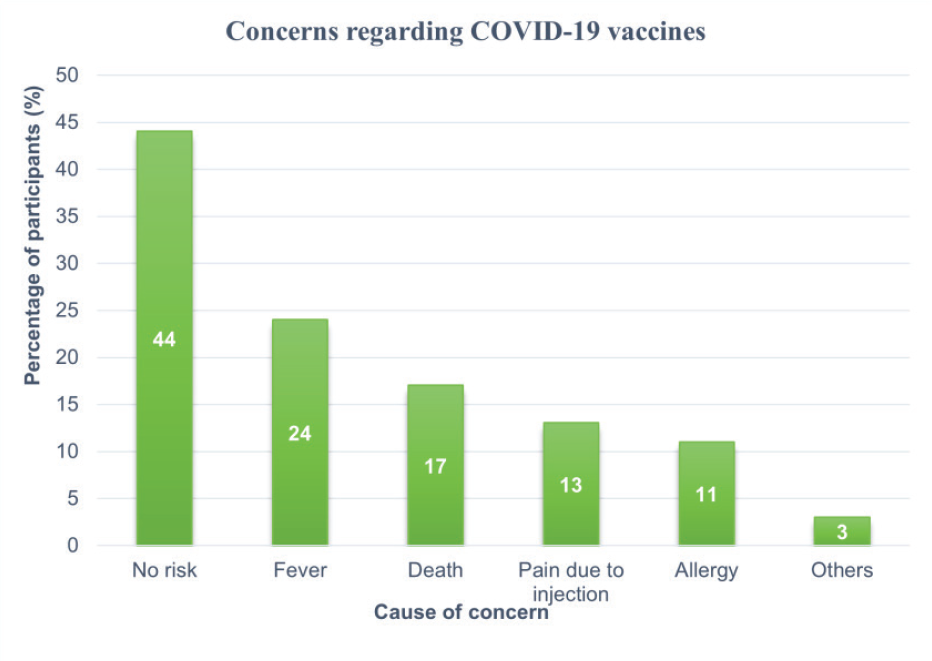
In our study, 56% of the population were concerned about the risk that might occur after being vaccinated. Fever (24%) and death (17%) were the most common concerns. Injection and allergy were the least common concerns
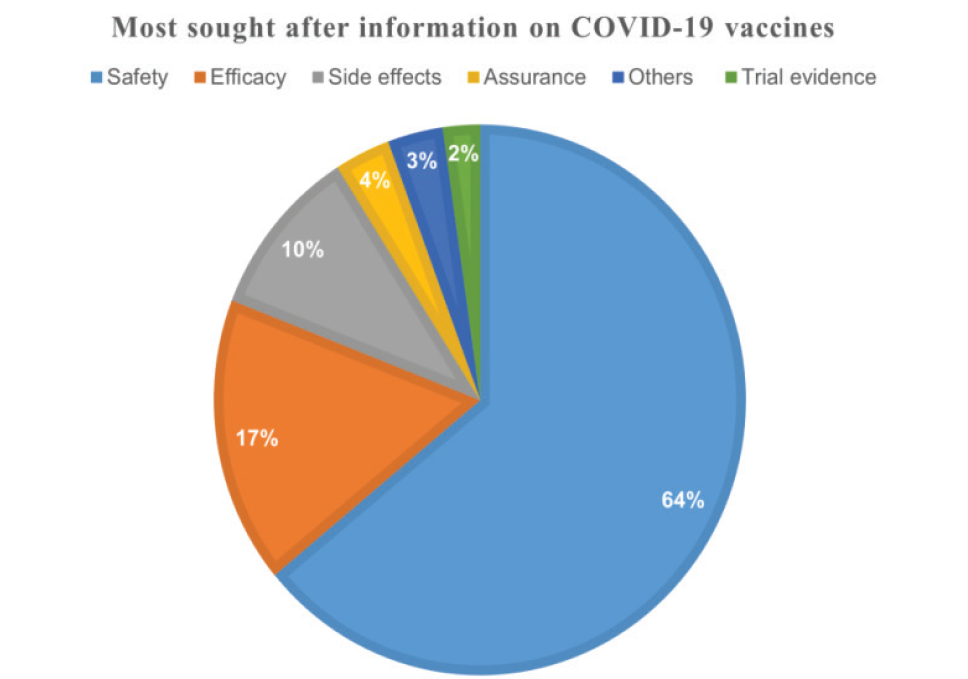
Safety (64%) was the most important information sought when the new vaccines came to market. This was followed by the efficacy (17%) of and information (10%) about the vaccine
Table 2. Factors affecting COVID-19 vaccine hesitancy
Factor | Wald | Sig. | Exp (B) | 95.0% CI for EXP (B) | |
|---|---|---|---|---|---|
Lower | Upper | ||||
Gender | 1.647 | 0.199 | 0.847 | 0.657 | 1.092 |
Occupation - healthcare professional | 19.931 | 0.000 | 3.354 | 1.972 | 5.705 |
Trust in vaccine manufacturing companies | 2.562 | 0.109 | 1.281 | 0.946 | 1.734 |
Negative publicity about vaccines | 13.843 | 0.000 | 0.615 | 0.476 | 0.794 |
Belief that vaccines are a risk to health | 0.302 | 0.583 | 0.921 | 0.688 | 1.234 |
Belief that vaccination will give you COVID-19 infection | 0.040 | 0.842 | 0.967 | 0.693 | 1.348 |
Vaccine mandate | 102.155 | 0.000 | 4.164 | 3.158 | 5.490 |
Societal pressure | 24.503 | 0.000 | 2.058 | 1.546 | 2.738 |
Influence of anti-vaccination groups | 5.378 | 0.020 | 0.734 | 0.565 | 0.953 |
Concern regarding the risks of the vaccine | 0.694 | 0.405 | 1.117 | 0.861 | 1.450 |
Belief that COVID-19 vaccines have been studied adequately | 19.008 | 0.000 | 1.829 | 1.394 | 2.400 |
Belief that COVID-19 vaccines are being adequately monitored for safety by the Government of India | 6.726 | 0.010 | 1.437 | 1.093 | 1.889 |
Need to get a booster dose | 0.917 | 0.338 | 1.137 | 0.874 | 1.478 |
Presence of a major illness | 45.986 | 0.000 | 0.400 | 0.307 | 0.521 |
History of COVID-19 infection in the past | 83.088 | 0.000 | 0.268 | 0.202 | 0.356 |
Vaccine endorsement by celebrities | 13.525 | 0.000 | 1.637 | 1.259 | 2.129 |
Ambiguity regarding time interval required between vaccine doses | 13.007 | 0.000 | 1.734 | 1.286 | 2.339 |
CI: Confidence interval
Subgroup analyses were performed based on age (), gender (), and education level (). For obtaining vaccine information, older adults relied mostly on television, whereas youngsters had equal preferences for television and social media. WhatsApp and Facebook had a similar degree of preference in both age groups (34% vs. 32%, 21% vs. 18%, p=0.0001). Older adults had greater preference for herbal supplements (59% vs. 47%, p=0.0001). Youngsters were more in favor of compulsory vaccination (49% vs. 33%, p=0.0001) and they were also under greater societal pressure to get themselves vaccinated (39% vs. 33%, p=0.018). The proportion of the unvaccinated population was higher in the older age group (79% vs. 73%, p=0.01032).
Table 3a. (a). Subgroup analysis - response of participants with respect to age
Variable/characteristic | n=1622 | p-value | ||
|---|---|---|---|---|
Age <40 n=967 | Age >40 n=655 | |||
1. | Sources used for information on COVID-19 vaccines Television Social media Newspaper/magazines Healthcare professionals Journal articles | 317 (32.8) 309 (31.9) 151 (15.6) 144 (14.9) 46 (4.8) | 314 (47.9) 99 (15.1) 118 (18) 98 (14.9) 26 (3.9) | 0.0001 |
2. | Social media used to acquire COVID-19 vaccine information. Did not trust social media YouTube | 325 (33.6) 202 (20.9) 201 (20.8) 165 (17) 49 (5.1) 25 (2.6) | 211 (32.2) 117 (17.9) 228 (34.8) 12 (1.8) 83 (12.7) 4 (0.6) | 0.0001 |
3. | How was negative information related to COVID-19 vaccines clarified? Ask a healthcare worker Check authenticity on the internet Ask a friend/family/relative Others | 343 (35.5) 309 (31.9) 308 (31.9) 7 (0.7) | 286 (43.7) 101 (15.4) 264 (40.3) 4 (0.6) | 0.0001 |
4. | Most trusted source for information on COVID-19 vaccines Healthcare worker Friend/family Social media Other | 574 (59.4) 256 (26.5) 123 (12.7) 14 (1.4) | 333 (50.8) 268 (40.9) 45 (6.9) 9 (1.4) | 0.0001 |
5. | Least trusted source for information on COVID-19 vaccines Social media Friend/family Healthcare worker Other | 487 (50.4) 365 (37.7) 107 (11) 8 (8.3) | 384 (58.6) 208 (31.8) 57 (8.7) 6 (0.9) | 0.011 |
6. | Do you believe herbal supplements are sufficient for immunity against COVID-19 infection? Yes No | 454 (46.9) 513 (53) | 383 (58.5) 272 (41.5) | 0.0001 |
7. | Most preferred COVID-19 vaccine Covishield Covaxin Sputnik Pfizer Moderna Other | 550 (56.9) 244 (25.2) 80 (8.3) 64 (6.6) 16 (1.7) 13 (1.3) | 458 (69.9) 141 (21.5) 17 (2.6) 30 (4.6) 4 (0.6) 5 (0.8) | 0.0001 |
8. | Attitude regarding Covishield and Covaxin: Covaxin and Covishield have equal safety and efficacy Covishield is safer and more effective than Covaxin Covaxin is safer and more effective than Covishield Both Covishield and Covaxin are harmful | 529 (54.7) 254 (26.3) 153 (15.8) 31 (3.2) | 444 (67.7) 133 (20.3) 61 (9.3) 17 (2.6) | 0.0001 |
9. | Should COVID-19 vaccine be made compulsory? Yes No | 469 (48.5) 498 (51.5) | 216 (32.9) 439 (67) | 0.0001 |
10. | Do you feel social pressure to get COVID-19 vaccine? Yes No | 373 (38.6) 594 (61.4) | 215 (32.8) 440 (67.2) | 0.018 |
11. | Do you believe that COVID-19 vaccination is a risk for your health? Yes No | 582 (60.2) 385 (39.8) | 327 (49.9) 328 (50) | 0.0001 |
12. | Are you willing to get vaccinated against COVID-19? Yes No | 553 (57) 414 (42.8) | 273 (42) 382 (58.3) | 0.0001 |
13. | Have you been vaccinated against COVID-19? Yes No | 258 (27) 709 (73.3) | 138 (21) 516 (78.8) | 0.01032 |
14. | Do you believe that the vaccine is not needed if the person has a history of COVID-19 infection in the past? No, it is still required. Yes, it is not required. | 697 (72) 270 (27.9) | 412 (62.9) 243 (37) | 0.0001 |
15. | Do you believe that celebrities can instill confidence in getting vaccinated against COVID-19 infection? Yes No | 381 (39.4) 586 (60.5) | 301(45.9) 354 (54) | 0.009 |
Table 3b. (b). Subgroup analysis - response of participants with respect to gender
Variable/characteristic | n=1622 | p-value | ||
|---|---|---|---|---|
Male n=977 | Female n=645 | |||
1. | Social media used for information on COVID-19 vaccines Do not trust social media YouTube | 348 (35.6) 226 (23.1) 213 (21.8) 93 (9.5) 77 (7.9) 20 (2) | 188 (29.1) 93 (14.4) 216 (33.5) 84 (13.0) 55 (8.5) 9 (1.4) | 0.0001 |
2. | Preferred route of administration for COVID-19 vaccines Injection Nasal spray Oral (tablet/syrup) Others | 777 (79.5) 103 (10.5) 87 (8.9) 10 (1) | 507 (78.6) 48 (7.4) 81 (125) 8 (1.2) | 0.026 |
3. | Does negative publicity influence your opinion about getting COVID-19 vaccines? Yes No | 565 (57.8) 412 (42.1) | 312 (48.3) 332 (51.4) | 0.0001 |
4. | Should COVID-19 vaccine be made compulsory? Yes No | 355 (36.3) 622 (63.6) | 330 (51.1) 315 (48.8) | 0.0001 |
5. | Do you feel social pressure to get COVID-19 vaccine? Yes No | 334 (51.8) 643 (65.8) | 254 (39.4) 391 (60.6) | 0.033 |
6. | Are you concerned about side effects of COVID-19 vaccines? Yes No | 502 (51.4) 475 (48.6) | 407 (63.1) 238 (36.9) | 0.0001 |
7. | Do you believe that the vaccine should not be taken by persons with major illnesses such as cancer, heart disease, kidney disease etc.? Yes No | 687 (70.3) 290 (29.7) | 394 (61.4) 251 (38.9) | 0.0001 |
8. | Are you willing to get vaccinated against COVID-19? Yes No | 446 (46) 531 (54.3) | 380 (59) 265 (41) | 0.0001 |
9. | Have you been vaccinated against COVID-19? Yes No | 207 (21) 769 (78.7) | 189 (29) 456 (70.7) | 0.0002 |
10. | Do you believe that the vaccine is not needed if the person has a history of COVID-19 infection in the past? No, it is still required. Yes, is it not required. | 636 (65) 341 (34.9) | 473 (73.3) 172 (26.7) | 0.0001 |
Table 3c. (c). Subgroup analysis - Response of participants with respect to education level
Variable/characteristic | n=1622 | p-value | ||
|---|---|---|---|---|
School level n=926 | College level n=696 | |||
1. | Sources used for information on COVID-19 vaccines Television Social media Newspaper/magazines Healthcare professionals Journal articles | 429 (46.3) 200 (21.6) 148 (15.9) 129 (13.9) 20 (2.2) | 202 (29.0) 208 (29.9) 94 (13.5) 140 (20.1) 52 (7.5) | 0.0001 |
2. | Social media used for information on COVID-19 vaccines Do not trust social media YouTube | 291 (31.4) 272 (29.4) 181 (19.5) 98 (10.6) 76 (8.2) 8 (0.9) | 245 (35.2) 157 (22.5) 138 (19.8) 34 (4.8) 101 (14.5) 21 (3.0) | 0.0001 |
3. | How was negative information related to COVID-19 vaccines clarified? Ask a friend/family/relative Ask a healthcare worker Check its authenticity in the internet Others | 363 (39.2) 352 (38.0) 206 (22.2) 5 (0.5) | 209 (30.0) 277 (39.8) 204 (29.3) 6 (0.8) | 0.0001 |
4. | Do you trust the companies manufacturing COVID-19 vaccines? Yes No | 712 (76.8) 214 (23.1) | 490 (70.4) 206 (29.5) | 0.003 |
5. | Do you believe herbal supplements are sufficient for immunity against COVID-19 infection? Yes No | 525 (56.7) 401 (43.3) | 312 (44.8) 384 (55.1) | 0.0001 |
6. | Do you believe COVID-19 vaccines strengthen the immune system? Yes No | 698 (75.4) 228 (24.6) | 483 (69.3) 213 (30.6) | 0.007 |
7. | Attitude regarding Covishield and Covaxin Covaxin and Covishield have equal safety and efficacy Covishield is safer and more effective than Covaxin Covaxin is safer and more effective than Covishield Both Covishield and Covaxin are equally harmful | 618 (66.7) 193 (20.8) 100 (10.8) 15 (1.6) | 355 (51.0) 194 (27.9) 114 (20.7) 33 (4.7) | 0.0001 |
8. | Does negative publicity influence your opinion about getting COVID-19 vaccines? Yes No | 566 (61.1) 360 (38.9) | 360 (51.7) 384 (55.1) | 0.0001 |
9. | Do you believe COVID-19 infection can occur even after vaccination? Yes No | 148 (15.9) 778 (84.0) | 171 (24.5) 525 (75.0) | 0.0001 |
10. | Should COVID-19 vaccine be made compulsory? Yes No | 323 (34.9) 603 (65.1) | 603 (86.6) 334 (48.0) | 0.0001 |
11. | Do you feel social pressure to get COVID-19 vaccine? Yes No | 282 (30.5) 644 (69.5) | 644 (92.5) 390 (56.0) | 0.0001 |
12. | Are you concerned about side effects of COVID-19 vaccines? Yes No | 474 (51.2) 452 (48.8) | 452 (65.0) 261 (37.5) | 0.0001 |
13. | Do you believe COVID-19 vaccines have been studied adequately? Yes No | 613 (66.2) 313 (33.8) | 313 (45.0) 285 (41.0) | 0.003 |
14. | Do you believe that the vaccine should not be taken by persons with major illnesses such as cancer, heart disease, kidney disease etc.? Yes No | 636 (68.7) 290 (31.3) | 445 (64.0) 251 (36.1) | 0.045 |
15. | Are you willing to be vaccinated against COVID-19? Yes No | 393 (42.0) 533 (57.6) | 433 (62.0) 263 (37.8) | 0.0001 |
16. | Have you been vaccinated against COVID-19? Yes No | 162 (17.0) 761 (82.2) | 232 (33.0) 464 (66.6) | 0.0001 |
17. | Do you believe that the vaccine is not needed if the person has a history of COVID-19 infection in the past? No, it is still required. Yes, it is not required. | 609 (65.8) 317 (34.2) | 500 (72.0) 196 (28.1) | 0.009 |
18. | Do you believe that celebrities can instill confidence in getting vaccinated against COVID-19 infection? Yes No | 410 (44.2) 516 (55.7) | 272 (49.1) 424 (61) | 0.036 |
19. | Do you think that people may lose interest in getting COVID-19 vaccine because of the time interval between the two doses? Yes No | 199 (21.5) 726 (78.4) | 219 (31.4) 477 (68.5) | 0.0001 |
Older adults felt celebrities taking a COVID-19 vaccine made them more confident in doing the same when compared to younger adults (46% vs. 39%, p=0.009).
22% of males and 34% of females did not trust social media for information on vaccines (chi-square statistic 27.27; p=0.0001). There was no difference in preference towards social media platforms between genders. WhatsApp and Facebook were the most popular, and Twitter was the least popular information source. A greater proportion of male respondents reported that they felt greater social pressure to get vaccinated (52% vs. 39%, p=0.03) and that the vaccine should not be taken by persons with major illnesses (70% vs. 61%, p=0.0001). Most female respondents believed that vaccines ought to be made compulsory for all (51% vs. 36%, p=0.0001). They were also more willing to get vaccinated against COVID-19 (59% vs. 46%, p=0.0001). And as expected, a greater proportion of males were found to be unvaccinated compared to females (79% vs. 71%, p=0.0002).
When subgroup analysis was done with respect to education level, it was seen that television was the most preferred information source among school - educated participants (46%), whereas television and social media were equally preferred among college-educated participants (29% vs. 30%, p=0.0001). WhatsApp was the most popular social media platform in both groups. The school-level population preferred herbal supplements for immunity against COVID-19 infection (57% vs. 45%, p=0.0001) and was more influenced by negative publicity about vaccines (61% vs. 52%, p=0.0001). A greater proportion in the college educated group wanted the vaccine to be made compulsory (87% vs. 35% p=0.0001) and felt greater societal pressure to take vaccines (93% vs. 31%, p=0.0001). Unwillingness to get vaccinated was more prevalent among the school-completed population (58% vs. 38%, p=0.0001) and as expected, a greater proportion of these participants remained unvaccinated (82% vs. 67%, p=0.0001).
DISCUSSION
Our study shows that 49% of study participants were unwilling to take vaccines. This finding resonates with an earlier study carried out across rural and urban groups in Tamil Nadu where 40.7% of participants were vaccine hesitant and 19.5% were vaccine deniers. Similarly, a 2019-2020 study done in Maharashtra, India, showed that 37% of participants were either unwilling or unsure about receiving vaccines. Although WHO and Center for Disease Control (CDC) have declared that COVID-19 is no longer a public health emergency, , herd immunity granted by vaccines still remains a formidable weapon against the disease at the community level, particularly in the face of new viral variants. Hence, it is essential that vaccine hesitancy be tackled effectively. At the time of data collection, more than ten months had passed since vaccine rollout, but the fact that half the study population was still unwilling to get vaccinated remains intriguing. One would expect that a greater degree of acceptance would have set in due to increasing knowledge gained about these vaccines.
Our study examined the various factors influencing vaccine hesitancy. Positive factors that reduced vaccine hesitancy included being a healthcare professional, the presence of a vaccine mandate, societal pressure to get vaccinated, the belief that COVID-19 vaccines have been adequately studied and are being monitored for safety by the government, endorsement of vaccines by celebrities, and ambiguity regarding the time interval required between vaccine doses. The higher acceptance of vaccines among healthcare professionals may be explained by their knowledge about the mechanisms underlying vaccination and its benefits, clinical experience, and the risk they face as frontline workers, especially during pandemics.On the other hand, they may also be reluctant to voice their hesitancy towards vaccines due to pressures from various organizations and their position as role models to the public. The introduction of a vaccine mandate appears to reduce vaccine hesitancy, possibly due to the fact that it is an authoritative decree that could impact several social activities, such as admission to schools and workplaces. It appears that the public perceives a vaccine mandate as a punitive strategy because 58% of our study population were against compulsory vaccination. They feel coercion is unwarranted as it forces them to take vaccines even when they are not personally convinced of their safety and efficacy. However, this is not the first instance of coercion for vaccination. For example, in the USA, children are expected to get vaccinated before attending school. Similarly, in Italy, fines are imposed if children do not take their regular vaccinations. The third factor that
appears to reduce vaccine hesitancy is societal pressure.
During the subgroup analysis, it was observed that unwillingness was more pronounced among males (54% vs. 41%; p<0.0001), probably due to greater social pressure from their employers to get vaccinated. However, few Indian studies report greater vaccine hesitancy among females. 42% of our participants agreed that endorsement from notable personalities could be a favorable factor in influencing public opinion. The regression analysis also arrived at the same conclusion. The trust that COVID-19 vaccines have been adequately studied and are being monitored for safety by the government were other factors that reduced vaccine hesitancy. 38% of our study population felt that COVID-19 vaccines were inadequately studied. A similar proportion believed the Indian Government had not sufficiently evaluated vaccine safety.
Some opined that more transparency was needed in sharing vaccine related information to the public. Although clinical trial results are available in the public domain, data from these trials are limited compared to the large vaccine roll-out database that the Indian Government has with respect to vaccine safety among recipients. Periodical disclosure of safety issues may elicit a greater degree of trust from the public. However, the authors are of the opinion that availability of more information could sometimes be counterproductive, if interpreted inappropriately.
Two of the factors that increased public vaccine hesitancy were negative publicity regarding vaccines and the influence of anti-vaccination groups. The presence of a major illness also made people hesitant to get vaccinated. Subgroup analysis revealed that older adults were more hesitant to get vaccinated, possibly due to greater fear with respect to safety issues and the presence of comorbidities. The majority of the participants also felt that taking vaccines in the presence of major illnesses such as cancer, heart or kidney disease was inappropriate, a perception shared among the various subgroups. An Indian survey among cancer patients revealed that 60% were vaccine hesitant, mainly for fear of the vaccine impacting cancer therapy, its side-effects, and lack of information. These findings are consistent with studies done in the USA and other low- and middle-income countries. A history of COVID-19 infection in the past was also a factor that contributed to increased vaccine hesitancy. Despite the government announcing that the vaccine can be taken 3 months after recovery from infection, 32% of the study population believed it was unnecessary for people who had a past history of COVID-19. This perception may have arisen from the knowledge that viral infections such as chickenpox and measles confer lifelong immunity to those infected once. However, experience has shown that naturally acquired immunity to COVID-19 is short-lasting and several thousand individuals were infected during both the first and second waves. The CDC states that vaccination can be delayed up to 3 post-infection months, but beyond that, booster doses with updated vaccines must be taken pr omptly. This becomes crucial as the coronavirus continues to mutate and new variants emerge. This fact does not seem to have registered in people’s minds, hence indicating the importance of communicating the need for vaccination even in those with a history of infection. Hesitancy was also higher among those with lesser education, a trend reported even in European and Canadian studies, . The major reasons for vaccine hesitancy among our participants were safety and availability ().
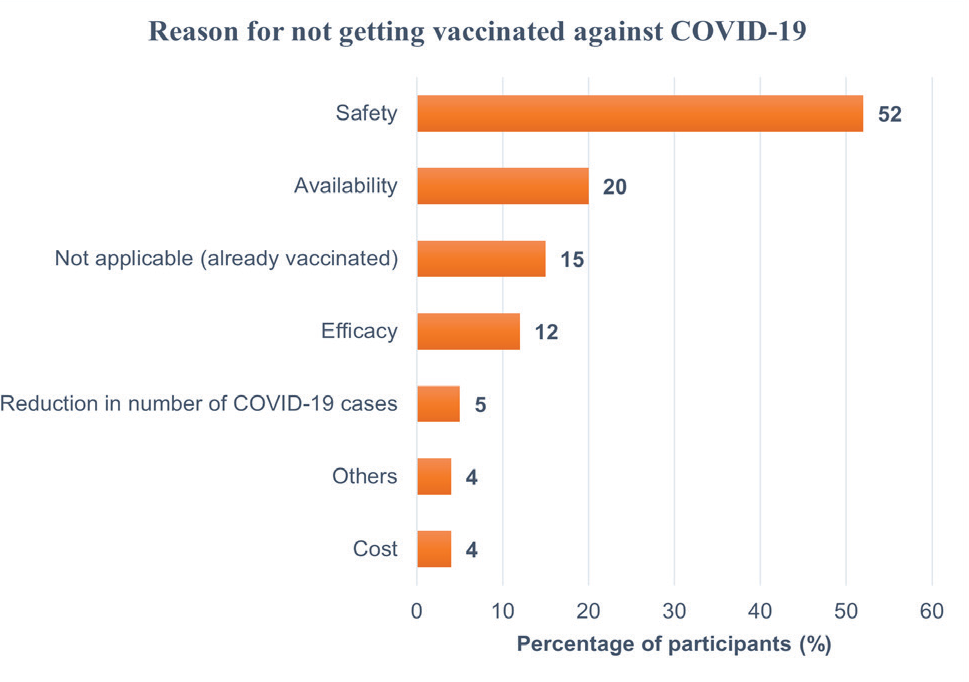
The major reason for not getting vaccination was safety concerns (52%), followed by availability (20%) and efficacy (12%). Cost (5%) and reduced case load of COVID-19 (4%) were other reasons for not getting the vaccine
Safety has been cited as a major concern even in earlier reports. This is despite the fact that the prevalence of serious adverse events due to COVID-19 vaccines is extremely low. This could be attributed to fear mongering tactics by peddlers of misinformation who circulate fallacies and raise doubts about the vaccines’ safety. In addition, it is a natural tendency for the human mind to succumb to ‘negativity bias’, i.e., it tends to remember the rare event of a serious adverse reaction occurring in one individual rather than the daily mundane news of millions taking the vaccine without any adverse reaction. Although the government undertook the herculean task of vaccinating the Indian population at a rapid pace, myths regarding vaccine safety still prevail. The CoWin platform, launched by the Indian government, was a welcome step that helped instill public faith in the government. This platform served as a digital backbone during the pandemic, helped increase transparency, and added credibility to the vaccination process. Collaborations between healthcare workers, activists, celebrities, and governmental and non-governmental organizations play key roles in this aspect.
In our study, television was the most preferred source of information about vaccines (38%). This pattern was more common among the elderly and in those with school-level education. This trend was also observed in a survey carried out in Israel, where the majority of respondents reported getting COVID-19 vaccine information from local television. The next important source of information was social media (25%), among which WhatsApp (33%) and Facebook (18%) were used by the majority. As anticipated, youngsters tended to use social media more when compared to the elderly (63% vs. 15%, p=0.0001). Similar results were seen in a health information national trends survey (2013, 2014, & 2017) in the USA, which reported significantly higher odds of the younger generation using social media for health communication. Although social media provides abundant information, respondents in our study have agreed that its authenticity remains questionable, and hence it was the least trusted source (54%). Likewise, a cross-sectional study in Saudi Arabia showed that the majority of the participants did not trust information from social media, with WhatsApp being their least trusted source. Participants placed reasonable trust in information obtained from healthcare workers (56%), but they reported that this was not easily accessible. Scholarly articles that had the most precise and authentic information about vaccines were the least commonly used sources. Thus, it is imperative that accurate information regarding vaccines is disseminated aggressively by healthcare authorities through non-traditional methods like social media and television. Public engagement by the healthcare community through television may help address double-minded fence-sitters.
More than half the study participants (52%) believed that traditional herbal supplements like Kabasura Kudineer were sufficient for immunity against COVID-19. Although studies have shown that this formulation has beneficial effects in improving viral clearance-, there are no studies to back its ability to prevent infection. Yet a good number of people do trust in its ability to prevent infection, thereby perpetrating a false sense of assurance.
Lessons learnt from COVID-19 vaccination may be extrapolated and used to tailor tactics that can improve vaccine acceptance rates during future pandemics. Efforts must be made early during the vaccine development period to understand the factors contributing to hesitancy. Infodemics are prevalent during any global crises, and the role played by the media is crucial during those times. As shown in our study, there is high information uptake from unreliable sources, making it imperative to ensure that data from infodemics are carefully filtered.
Study Limitations
Firstly, although the study attempted to gauge perception and behavioral practices towards COVID-19 vaccination among adults across Tamil Nadu, certain regions of the state were relatively underrepresented. However, care was taken to ensure that urban, semi-urban, and rural populations were included in the study. Secondly, the survey was done online for one-third of participants. Hence, the possibility of them not comprehending the questions cannot be ruled out. Thirdly, since vaccine hesitancy ebbs and flows as time progresses and more information becomes available, a follow-up study would have proven beneficial. But this was not included in the protocol for our study.
CONCLUSION
Age, gender, education level, and social media play major roles in formulating beliefs and thus determining the degree of public hesitancy toward vaccines. Our study showed that even after a year of the pandemic, vaccine hesitancy in a progressive state such as Tamil Nadu, India, was disturbingly high. This warrants increasing efforts to educate the public on the effectiveness and safety of vaccines. Greater engagement of healthcare workers through social media on the beneficial effects of vaccination is pivotal. Adequate measures must be ensured to convey accurate information and to increase public vaccine literacy through reliable sources.
Ethics
Ethics Committee Approval: The study was SRM Medical College Hospital and Research Centre initiated after getting approval from the Ethics Committee of our institution (approval number:2871/IEC/2021, date: 23.01.2021) and registration in the Clinical Trial Registry of India (CTRI/2021/08/035885).
Informed Consent: After a proper explanation of the study purpose and the acquisition of written informed consent from the participants, information was collected using an author-designed, internally validated questionnaire.
Footnotes
Authorship Contributions
Concept: M.G., Design: M.G., Data Collection or Processing: I.P., C.S.C., B.G.R., A.K.M., N.K.D., V.P.J.S., Analysis or Interpretation: M.G., K.M., I.P., V.P.J.S., Literature Search: K.M., J.J., C.S.C., Writing: M.G., K.M., J.J., C.S.C.
Conflict of Interest: No conflict of interest was declared by the authors.
Financial Disclosure: The authors declared that this study received no financial support.
Tablo 3a. (a). Alt grup analizi - yaşa göre katılımcıların yanıtı
Değişken/özellik | n=1622 | p-değeri | ||
|---|---|---|---|---|
Yaş <40 n=967 | Yaş >40 n=655 | |||
1. | COVID-19 aşıları hakkında bilgi edinmek için kullanılan kaynaklar Televizyon Sosyal medya Gazete/dergi Sağlık çalışanları Akademik dergi makaleleri | 317 (32,8) 309 (31,9) 151 (15,6) 144 (14,9) 46 (4,8) | 314(47,9) 99 (15,1) 118 (18) 98 (14,9) 26 (3,9) | 0,0001 |
2. | COVID-19 aşısı hakkında bilgi edinmek için kullanılan Sosyal medya Sosyal medyaya güvenmiyor YouTube | 325 (33,6) 202 (20,9) 201 (20,8) 165 (17) 49 (5,1) 25 (2,6) | 211 (32,2) 117 (17,9) 228 (34,8) 12 (1,8) 83 (12,7) 4 (0,6) | 0,0001 |
3. | Covid-19 aşılarla ilgili olumsuz bilgiler nasıl aydınlatıldı? Bir sağlık çalışanına sorarak İnternette geçerliliği kontrol ederek Bir arkadaş/aile/akrabaya sorarak Diğerleri | 343 (35,5) 309 (31,9) 308 (31,9) 7 (0,7) | 286 (43,7) 101 (15,4) 264 (40,3) 4 (0,6) | 0,0001 |
4. | Covid-19 aşıları hakkında bilgi için en güvenilir kaynak Sağlık çalışanı Arkadaş/aile Sosyal medya Diğer | 574 (59,4) 256 (26,5) 123 (12,7) 14 (1,4) | 333 (50,8) 268 (40,9) 45 (6,9) 9 (1,4) | 0,0001 |
5. | Covid-19 aşıları hakkında bilgi için en az güvenilir kaynak Sosyal medya Arkadaş/aile Sağlık çalışanı Diğer | 487 (50,4) 365 (37,7) 107 (11) 8 (8,3) | 384 (58,6) 208 (31,8) 57 (8,7) 6 (0,9) | 0,011 |
6. | Bitkisel takviyelerin Covid-19 enfeksiyonuna karşı bağışıklık için yeterli olduğuna inanıyor musunuz? Evet Hayır | 454 (46,9) 513 (53) | 383 (58,5) 272 (41,5) | 0,0001 |
7. | En çok tercih edilen Covid-19 aşısı Covishield Covaxin Sputnik Pfizer Moderna Diğer | 550 (56,9) 244 (25,2) 80 (8,3) 64 (6,6) 16 (1,7) 13 (1,3) | 458 (69,9) 141 (21,5) 17 (2,6) 30 (4,6) 4 (0,6) 5 (0,8) | 0,0001 |
8. | Covishield ve Covaxin ile ilgili düşünceler Covaxin ve Covishield eşit güvenlik ve etkinliğe sahip Covishield Covaxin’den daha güvenli ve daha etkin Covaxin Covishield’den daha güvenli ve daha etkin Hem Covishield hem de Covaxin zararlı | 529 (54,7) 254 (26,3) 153 (15,8) 31 (3,2) | 444 (67,7) 133 (20,3) 61 (9,3) 17 (2,6) | 0,0001 |
9. | Covid-19 aşısı zorunlu hale getirilmeli mi? Evet Hayır | 469 (48,5) 498 (51,5) | 216 (32,9) 439 (67) | 0,0001 |
10. | Covid-19 aşısı olmak için sosyal baskı hissediyor musunuz? Evet Hayır | 373 (38,6) 594 (61,4) | 215 (32,8) 440 (67,2) | 0,018 |
11. | COVID-19 aşısının sağlığınız için bir risk olduğuna inanıyor musunuz? Evet Hayır | 582 (60,2) 385 (39,8) | 327 (49,9) 328 (50) | 0,0001 |
12. | Covid-19’a karşı aşılanmaya istekli misiniz? Evet Hayır | 553 (57) 414 (42,8) | 273 (42) 382 (58,3) | 0,0001 |
13. | Covid-19’a karşı aşılandınız mı? Evet Hayır | 258 (27) 709 (73,3) | 138 (21) 516 (78,8) | 0,01032 |
14. | Kişinin geçmişte Covid-19 enfeksiyon öyküsü varsa aşının gerekli olmadığına inanıyor musunuz? Hayır, halen gerekiyor. Evet, gerekmiyor. | 697 (72) 270 (27,9) | 412 (62,9) 243 (37) | 0,0001 |
15. | Ünlülerin Covid-19 enfeksiyonuna karşı aşılanma konusunda güven aşılayabileceğine inanıyor musunuz? Evet Hayır | 381 (39,4) 586 (60,5) | 301(45,9) 354 (54) | 0,009 |
GA: Güven aralığı
Tablo 3b. (b). Alt grup analizi - cinsiyete göre katılımcıların yanıtı
Değişken/özellik | n=1622 | p-değeri | ||
|---|---|---|---|---|
Erkek n=977 | Kadın n=645 | |||
1. | COVID-19 aşıları hakkında bilgi alınan sosyal medya kaynakları Sosyal medyaya güvenmiyor YouTube | 348 (35,6) 226 (23,1) 213 (21,8) 93 (9,5) 77 (7,9) 20 (2) | 188 (29,1) 93 (14,4) 216 (33,5) 84 (13,0) 55 (8,5) 9 (1,4) | 0,0001 |
2. | Covid-19 aşıları için tercih edilen uygulama yolu Enjeksiyon Nazal sprey Oral (tablet/şurup) Diğerleri | 777 (79,5) 103 (10,5) 87 (8,9) 10 (1) | 507 (78,6) 48 (7,4) 81 (125) 8 (1,2) | 0,026 |
3. | Olumsuz tanıtım, Covid-19 aşısı olma konusundaki fikrinizi etkiler mi? Evet Hayır | 565 (57,8) 412 (42,1) | 312 (48,3) 332 (51,4) | 0,0001 |
4. | Covid-19 aşısı zorunlu hale getirilmeli mi? Evet Hayır | 355 (36,3) 622 (63,6) | 330 (51,1) 315 (48,8) | 0,0001 |
5. | Covid-19 aşısı olmak için sosyal baskı hissediyor musunuz? Evet Hayır | 334 (51,8) 643 (65,8) | 254 (39,4) 391 (60,6) | 0,033 |
6. | Covid-19 aşılarının yan etkilerinden endişe duyuyor musunuz? Evet Hayır | 502 (51,4) 475 (48,6) | 407 (63,1) 238 (36,9) | 0,0001 |
7. | Aşının kanser, kalp hastalığı, böbrek hastalığı vb. majör hastalıkları olan kişiler tarafından alınmaması gerektiğine inanıyor musunuz? Evet Hayır | 687 (70,3) 290 (29,7) | 394 (61,4) 251 (38,9) | 0,0001 |
8. | Covid-19’a karşı aşılanmaya istekli misiniz? Evet Hayır | 446 (46) 531 (54,3) | 380 (59) 265 (41) | 0,0001 |
9. | Covid-19’a karşı aşılandınız mı? Evet Hayır | 207 (21) 769 (78,7) | 189 (29) 456 (70,7) | 0,0002 |
10. | Kişinin geçmişte Covid-19 enfeksiyon öyküsü varsa aşının gerekli olmadığına inanıyor musunuz? Hayır, halen gerekiyor. Evet, gerekmiyor. | 636 (65) 341 (34,9) | 473 (73,3) 172 (26,7) | 0,0001 |
Tablo 3c. (c). Alt grup analizi - eğitim seviyesine göre katılımcıların yanıtı
Değişken/özellik | n=1622 | p-değeri | ||
|---|---|---|---|---|
Okul derecesi n=926 | Lise derecesi n=696 | |||
1. | COVID-19 aşıları hakkında bilgi alınan kaynaklar Televizyon Sosyal medya Gazete/dergi Sağlık çalışanları Akademik dergi makaleleri | 429 (46,3) 200 (21,6) 148 (15,9) 129 (13,9) 20 (2,2) | 202 (29,0) 208 (29,9) 94 (13,5) 140 (20,1) 52 (7,5) | 0,0001 |
2. | COVID-19 aşıları hakkında bilgi alınan sosyal medya kaynakları Sosyal medyaya güvenmiyor YouTube | 291 (31,4) 272 (29,4) 181 (19,5) 98 (10,6) 76 (8,2) 8 (0,9) | 245 (35,2) 157 (22,5) 138 (19,8) 34 (4,8) 101 (14,5) 21 (3,0) | 0,0001 |
3. | Covid-19 aşılarla ilgili olumsuz bilgiler nasıl aydınlatıldı? Bir arkadaş/aile/akrabaya sorarak Bir sağlık çalışanına sorarak İnternette geçerliliği kontrol ederek Diğerleri | 363 (39,2) 352 (38,0) 206 (22,2) 5 (0,5) | 209 (30,0) 277 (39,8) 204 (29,3) 6 (0,8) | 0,0001 |
4. | Covid-19 aşılar üreten şirketlere güveniyor musunuz? Evet Hayır | 712 (76,8) 214 (23,1) | 490 (70,4) 206 (29,5) | 0,003 |
5. | Bitkisel takviyelerin Covid-19 enfeksiyonuna karşı bağışıklık için yeterli olduğuna inanıyor musunuz? Evet Hayır | 525 (56,7) 401 (43,3) | 312 (44,8) 384 (55,1) | 0,0001 |
6. | Covid-19 aşılarının bağışıklık sistemini güçlendirdiğine inanıyor musunuz? Evet Hayır | 698 (75,4) 228 (24,6) | 483 (69,3) 213 (30,6) | 0,007 |
7. | Covishield ve Covaxin ile ilgili düşünceler Covaxin ve Covishield eşit güvenlik ve etkinliğe sahip Covishield Covaxin’den daha güvenli ve daha etkin Covaxin Covishield’den daha güvenli ve daha etkin Hem Covishield hem de Covaxin zararlı | 618 (66,7) 193 (20,8) 100 (10,8) 15 (1,6) | 355 (51,0) 194 (27,9) 114 (20,7) 33 (4,7) | 0,0001 |
8. | Olumsuz tanıtım, Covid-19 aşısı olma konusundaki fikrinizi etkiler mi? Evet Hayır | 566 (61,1) 360 (38,9) | 360 (51,7) 384 (55,1) | 0,0001 |
9. | Covid-19 enfeksiyonunun aşılamadan sonra bile ortaya çıkabileceğini düşünüyor musunuz? Evet Hayır | 148 (15,9) 778 (84,0) | 171 (24,5) 525 (75,0) | 0,0001 |
10. | Covid-19 aşısı zorunlu hale getirilmeli mi? Evet Hayır | 323 (34,9) 603 (65,1) | 603 (86,6) 334 (48,0) | 0,0001 |
11. | Covid-19 aşısı olmak için sosyal baskı hissediyor musunuz? Evet Hayır | 282 (30,5) 644 (69,5) | 644 (92,5) 390 (56,0) | 0,0001 |
12. | Covid-19 aşılarının yan etkilerinden endişe duyuyor musunuz? Evet Hayır | 474 (51,2) 452 (48,8) | 452 (65,0) 261 (37,5) | 0,0001 |
13. | Covid-19 aşılarının yeterince çalışıldığına inanıyor musunuz? Evet Hayır | 613 (66,2) 313 (33,8) | 313 (45,0) 285 (41,0) | 0,003 |
14. | Aşının kanser, kalp hastalığı, böbrek hastalığı vb. majör hastalıkları olan kişiler tarafından alınmaması gerektiğine inanıyor musunuz? Evet Hayır | 636 (68,7) 290 (31,3) | 445 (64,0) 251 (36,1) | 0,045 |
15. | Covid-19’a karşı aşılanmaya istekli misiniz? Evet Hayır | 393 (42,0) 533 (57,6) | 433 (62,0) 263 (37,8) | 0,0001 |
16. | Covid-19’a karşı aşılandınız mı? Evet Hayır | 162 (17,0) 761 (82,2) | 232 (33,0) 464 (66,6) | 0,0001 |
17. | Kişinin geçmişte Covid-19 enfeksiyon öyküsü varsa aşının gerekli olmadığına inanıyor musunuz? Hayır, halen gerekiyor. Evet, gerekmiyor. | 609 (65,8) 317 (34,2) | 500 (72,0) 196 (28,1) | 0,009 |
18. | Ünlülerin Covid-19 enfeksiyonuna karşı aşılanma konusunda güven aşılayabileceğine inanıyor musunuz? Evet Hayır | 410 (44,2) 516 (55,7) | 272 (49,1) 424 (61) | 0,036 |
19. | İki doz arasındaki zaman aralığı nedeniyle Covid-19 aşısına olan ilgiyi kaybettiniz mi? Evet Hayır | 199 (21,5) 726 (78,4) | 219 (31,4) 477 (68,5) | 0,0001 |
Footnotes
Ethics
Ethics Committee Approval: The study was SRM Medical College Hospital and Research Centre initiated after getting approval from the Ethics Committee of our institution (approval number:2871/IEC/2021, date: 23.01.2021) and registration in the Clinical Trial Registry of India (CTRI/2021/08/035885).
Informed Consent: After a proper explanation of the study purpose and the acquisition of written informed consent from the participants, information was collected using an author-designed, internally validated questionnaire.
Footnotes
Authorship Contributions
Concept: M.G., Design: M.G., Data Collection or Processing: I.P., C.S.C., B.G.R., A.K.M., N.K.D., V.P.J.S., Analysis or Interpretation: M.G., K.M., I.P., V.P.J.S., Literature Search: K.M., J.J., C.S.C., Writing: M.G., K.M., J.J., C.S.C.
Conflict of Interest: No conflict of interest was declared by the authors.
Financial Disclosure: The authors declared that this study received no financial support.
References
Immunization and child health | UNICEF India [Internet]. [cited 2024 Aug 14]. https://www.unicef.org/india/what-we-do/immunization.
Immunization: national health mission [Internet]. [cited 2024 Aug 14]. https://nhm.gov.in/index1.php?lang=1&level=2&sublinkid=824&lid=220.
U-WIN [Internet]. [cited 2024 Aug 14]. https://uwin.mohfw.gov.in/home.
Vaccine hesitancy: Definition, scope and determinants - ClinicalKey [Internet]. [cited 2024 May 15]. https://www.clinicalkey.com/#!/content/play Content/ 1-s2.0-S0264410X15005009?returnurl=https:%2F%2 Flinkinghub.elsevier.com%2Fretrieve%2Fpii%2FS0264410X15005009 %3Fshowall% 3Dtrue&referrer= https:%2F%2Fpubmed.ncbi.nlm.nih.gov%2F.
Martini M, Bifulco M, Orsini D. Smallpox vaccination and vaccine hesitancy in the kingdom of the two sicilies (1801) and the great modernity of Ferdinand IV of Bourbon: a glimpse of the past in the era of the SARS-COV-2 (COVID-19) pandemic. Public Health. 2022;213:47-53.
Nguyen KH, Srivastav A, Lindley MC, Fisher A, Kim D, Greby SM, et al. Parental vaccine hesitancy and association with childhood diphtheria, tetanus toxoid, and acellular pertussis; measles, mumps, and rubella; rotavirus; and combined 7-series vaccination. Am J Prev Med. 2022;62:367-76.
Novilla MLB, Goates MC, Redelfs AH, Quenzer M, Novilla LKB, Leffler T, et al. Why parents say no to having their children vaccinated against measles: a systematic review of the social determinants of parental perceptions on mmr vaccine hesitancy. Vaccines (Basel). 2023;11:926.
Beavis AL, Meek K, Moran MB, Fleszar L, Adler S, Rositch AF. Exploring HPV vaccine hesitant parents’ perspectives on decision-making and motivators for vaccination. Vaccine X. 2022;12:100231.
Ten health issues WHO will tackle this year [Internet]. [cited 2024 Jan 12]. https://www.who.int/news-room/spotlight/ten-threats-to-global-health-in-2019.
COVID-19: Vaccines - UpToDate [Internet]. [cited 2024 Feb 21]. https://www.uptodate.com/contents/covid-19-vaccines.
COVAXIN - India’s first indigenous Covid-19 vaccine | Bharat Biotech [Internet]. [cited 2024 Mar 2]. https://www.bharatbiotech.com/covaxin.html.
Kaur U, Ojha B, Pathak BK, Singh A, Giri KR, Singh A, et al. A prospective observational safety study on ChAdOx1 nCoV-19 corona virus vaccine (recombinant) use in healthcare workers- first results from India. EClinicalMedicine. 2021;38:101038.
MoHFW | Home [Internet]. [cited 2024 May 18]. https://www.mohfw.gov.in/
Majority of Africans would take a safe and effective COVID-19 vaccine [Internet]. Africa CDC. [cited 2024 May 17]. https://africacdc.org/news-item/majority-of-africans-would-take-a-safe-and-effective-covid-19-vaccine/.
Soares P, Rocha JV, Moniz M, Gama A, Laires PA, Pedro AR, et al. Factors associated with COVID-19 vaccine hesitancy. Vaccines. 2021;9:300.
Murphy J, Vallières F, Bentall RP, Shevlin M, McBride O, Hartman TK, et al. Psychological characteristics associated with COVID-19 vaccine hesitancy and resistance in Ireland and the United Kingdom. Nat Commun. 2021;12:29.
Yoda T, Katsuyama H. Willingness to Receive COVID-19 Vaccination in Japan. Vaccines (Basel). 2021;9:48.
Williams L, Flowers P, McLeod J, Young D, Rollins L; The catalyst project team. social patterning and stability of intention to accept a COVID-19 vaccine in scotland: will those most at risk accept a vaccine? Vaccines (Basel). 2021;9:17.
Fisher KA, Bloomstone SJ, Walder J, Crawford S, Fouayzi H, Mazor KM. Attitudes toward a potential SARS-CoV-2 Vaccine : A survey of U.S. adults. ann intern Med. 2020;173:964-73.
Covid-19 vaccination in India - vaccinate India [Internet]. [cited 2024 Jan 23]. https://vaccinate-india.in/dashboard.
Danabal KGM, Magesh SS, Saravanan S, Gopichandran V. Attitude towards COVID 19 vaccines and vaccine hesitancy in urban and rural communities in Tamil Nadu, India - a community based survey. BMC Health Serv Res. 2021;21:994.
Umakanthan S, Patil S, Subramaniam N, Sharma R. COVID-19 Vaccine hesitancy and resistance in India Explored through a population-based longitudinal survey. Vaccines (Basel). 2021;9:1064.
WHO chief declares end to COVID-19 as a global health emergency | UN News [Internet]. 2023 [cited 2024 Jan 12]. https://news.un.org/en/story/2023/05/1136367.
CDC. Centers for disease control and prevention. 2020 [cited 2024 Mar 2]. COVID-19 and Your Health. https://www.cdc.gov/coronavirus/2019-ncov/your-health/end-of-phe.html.
Peterson CJ, Lee B, Nugent K. COVID-19 Vaccination hesitancy among healthcare workers-a review. Vaccines (Basel). 2022;10:948.
Savulescu J. Good reasons to vaccinate: mandatory or payment for risk? J Med Ethics. 2021;47:78-85.
Noronha V, Abraham G, Bondili S, Rajpurohit A, Menon R, Gattani S, et al. COVID-19 vaccine uptake and vaccine hesitancy in Indian patients with cancer: A questionnaire-based survey. Cancer Res Stat Treat. 2021;4:211-8.
Brandt EJ, Rosenberg J, Waselewski ME, Amaro X, Wasag J, Chang T. National Study of youth opinions on vaccination for COVID-19 in the U.S. J Adolesc Health. 2021;68:869-72.
Sarkar A, Chakrabarti AK, Dutta S. Covid-19 Infection in India: A comparative analysis of the second wave with the first wave. Pathogens. 2021;10:1222.
Syan SK, Gohari MR, Levitt EE, Belisario K, Gillard J, DeJesus J, et al. COVID-19 vaccine perceptions and differences by sex, age, and education in 1,367 community adults in ontario. Front Public Health. 2021;9:719665.
Humer E, Jesser A, Plener PL, Probst T, Pieh C. Education level and COVID-19 vaccination willingness in adolescents. Eur Child Adolesc Psychiatry. 2023;32:537-9.
Chandani S, Jani D, Sahu PK, Kataria U, Suryawanshi S, Khubchandani J, et al. COVID-19 vaccination hesitancy in India: State of the nation and priorities for research. Brain Behav Immun Health. 2021;18:100375.
Piltch-Loeb R, Savoia E, Goldberg B, Hughes B, Verhey T, Kayyem J, et al. Examining the effect of information channel on COVID-19 vaccine acceptance. PLos One. 2021;16:e0251095.
Huo J, Desai R, Hong YR, Turner K, Mainous AG 3rd, Bian J. Use of social media in health communication: findings from the health information national trends survey 2013, 2014, and 2017. Cancer Control. 2019;26:1073274819841442.
Alduraywish SA, Altamimi LA, Aldhuwayhi RA, AlZamil LR, Alzeghayer LY, Alsaleh FS, et al. Sources of health information and their impacts on medical knowledge perception among the saudi arabian population: cross-sectional study. J Med Internet Res. 2020;22:e14414.
Swoboda CM, Van Hulle JM, McAlearney AS, Huerta TR. Odds of talking to healthcare providers as the initial source of healthcare information: updated cross-sectional results from the Health Information National Trends Survey (HINTS). BMC Fam Pract. 2018;19:146.
Meenakumari R, Thangaraj K, Sundaram A, Sundaram MM, Shanmugapriya P, Mariappan A, et al. Clinical outcomes among COVID-19 patients managed with modern and traditional Siddha medicine - A retrospective cohort study. J Ayurveda Integr Med. 2022;13:100470.
Natarajan S, Anbarasi C, Sathiyarajeswaran P, Manickam P, Geetha S, Kathiravan R, et al. Kabasura Kudineer (KSK), a poly-herbal Siddha medicine, reduced SARS-CoV-2 viral load in asymptomatic COVID-19 individuals as compared to vitamin C and zinc supplementation: findings from a prospective, exploratory, open-labeled, comparative, randomized controlled trial, Tamil Nadu, India. Trials. 2021;22:623.
Srivastava A, Rengaraju M, Srivastava S, Narayanan V, Gupta V, Upadhayay R, et al. Efficacy of two siddha polyherbal decoctions, Nilavembu Kudineer and Kaba Sura Kudineer, along with standard allopathy treatment in the management of mild to moderate symptomatic COVID-19 patients-a double-blind, placebo-controlled, clinical trial. Trials. 2021;22:570.