
To the Editor,
Chylous pericardial effusion is an exceptionally rare manifestation of lymphatic system disruption, and its optimal management remains unclear due to the absence of standardized treatment strategies. Most available evidence is limited to isolated case reports, and treatment approaches are largely extrapolated from chylothorax, . A 36-year-old male presented with progressive dyspnea and persistent pericardial effusion. Thoracic computed tomography demonstrated circumferential pericardial fluid without mediastinal pathology (). A uniportal video-assisted thoracoscopic pericardial window revealed milky fluid (), and biochemical analysis confirmed chylous pericardial effusion with a triglyceride level of 3670 mg/dL. Conservative management, including dietary restriction and continuous intravenous somatostatin infusion, was initiated. Although pericardial drainage initially decreased, the patient subsequently developed symptomatic chylothorax, indicating failure of conservative therapy. Following left-sided tube thoracostomy and clinical stabilization, open transabdominal cisterna chyli ligation via laparotomy was performed by the thoracic surgery team (). The postoperative course was uneventful, and no recurrence of pericardial or pleural effusion was observed at 6-month follow-up (). Thoracic duct ligation is widely accepted as the standard surgical approach for chylous effusions. However, in cases with predominant pericardial involvement and complex lymphatic anatomy, thoracic duct ligation alone may not address all potential lymphatic communications. Thoracic duct ligation was not considered the preferred initial strategy because no imaging or intraoperative findings suggested a focal thoracic duct injury, while the initial and predominant manifestation was chylous pericardial effusion. In the present case, the subsequent development of chylothorax following initial presentation with isolated chylopericardium did not definitively localize the site of leakage. Nevertheless, the predominance of pericardial involvement, the absence of mediastinal pathology on imaging, and the lack of evidence for a focal thoracic duct injury led us to favor a more proximal lymphatic control strategy. Therefore, transabdominal cisterna chyli ligation was selected as an anatomically targeted approach. Only a limited number of reports have described transabdominal management in patients with chylous pericardial effusion. Rivera-Beltrán et al. reported successful transabdominal thoracic duct ligation combined with pericardial-peritoneal shunting in a pediatric patient with primary idiopathic chylopericardium. In contrast, our patient was an adult with refractory chylous pericardial effusion who subsequently developed chylothorax and was successfully treated with isolated transabdominal cisterna chyli ligation. In addition, our previously reported experience with transabdominal cisterna chyli ligation in refractory chylothorax further supports the feasibility of this approach. Our case adds to this limited experience and emphasizes that surgical strategy should be guided by the predominant site of chylous involvement rather than a routine thoracic duct ligation approach.
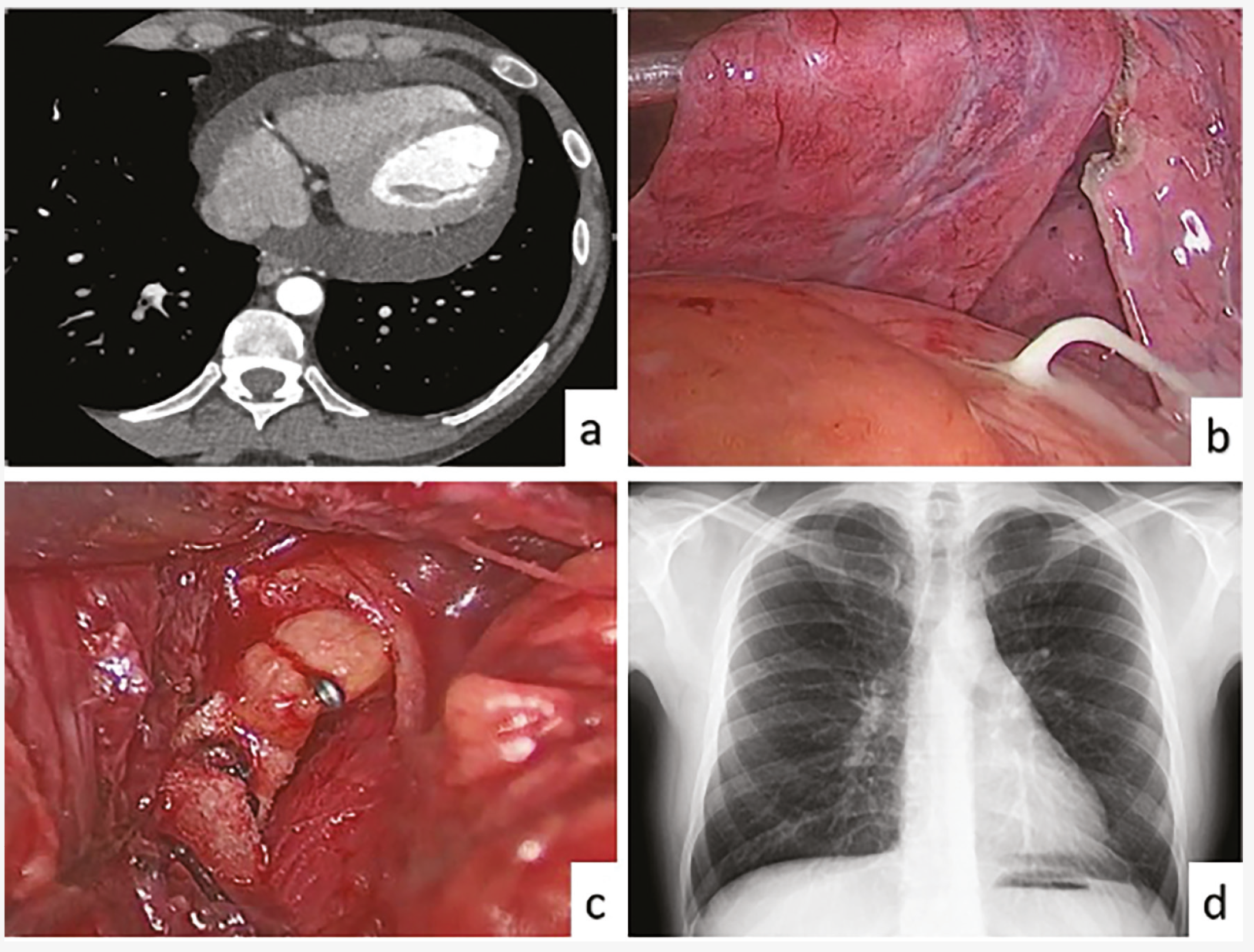
(a) Preoperative thoracic computed tomography showing circumferential pericardial effusion
(b) Intraoperative view of chylous fluid during video-assisted thoracoscopic pericardial window
(c) Transabdominal exposure and ligation of the cisterna chyli
(d) Postoperative chest radiograph demonstrating complete resolution of pericardial and pleural effusions
Footnotes
Authorship Contributions
Surgical and Medical Practices: Ç.Ç., Concept: Ç.Ç., A.S., M.E.K., Design: H.F.B., Data Collection or Processing: Ç.Ç., P.Ç.D., Analysis or Interpretation: Ç.Ç., A.S., M.E.K., Literature Search: Ç.Ç., P.Ç.D., Writing: Ç.Ç., H.F.B.
Conflict of Interest: No conflict of interest was declared by the authors.
Financial Disclosure: The authors declared that this study received no financial support.
References
Bhatnagar M, Fisher A, Ramsaroop S, Carter A, Pippard B. Chylothorax: pathophysiology, diagnosis, and management-a comprehensive review. J Thorac Dis. 2024;16:1645-61.
Rochefort MM. Review of chylopericardium. Mediastinum. 2022;6:3.
Shigeno T, Okuno K, Ogo T, Tanioka T, Kawada K, Fujiwara H, et al. The efficacy of thoracic duct ligation for post-esophagectomy chylothorax in esophageal cancer: a nationwide inpatient cohort study. Surg Oncol. 2025;63:102279.
Rivera-Beltrán S, Ortíz VN, Díaz R, Hernández JA. Transabdominal ligation of the thoracic duct with pericardial-peritoneal shunting in a case of primary idiopathic chylous pericardial effusion. J Pediatr Surg. 2013;48:1434-7.
Çetinkaya Ç, Batırel HF. Open transabdominal cisterna chyli ligation for refractory chylothorax: a retrospective case series. BMC Surg. 2025;26:76.