
Abstract
Aim
This school-based cross-sectional study aimed to determine the proportion of school-age children who screened positive for asthma- and allergy-related symptoms and to identify associated child- and parent-level factors.
Materials and Methods
This cross-sectional study was conducted among children attending grades 2-7 at a single school in İstanbul. Data were collected using a structured Child and Parent Information Form and the School-Based Asthma and Allergy Screening Questionnaire (SBASQ), which comprises a parent/caregiver questionnaire (PQ) and a student questionnaire (SQ). SBASQ cut-off scores were used to identify screening-positive results for asthma- and allergy-related symptoms. A total of 379 children with complete questionnaires were included in the analysis.
Results
The mean age of participants was 10.09±1.97 (7-14) years, and 62.8% were aged 7-10 years. Based on the PQ, 27.7% of children screened positive for asthma-related symptoms and 68.1% for allergy-related symptoms; corresponding proportions based on the SQ were 25.3% and 63.6%, respectively. Antibiotic use during the first year of life and a history of respiratory disease before the age of two years were significantly associated with higher screening-positive rates for both asthma- and allergy-related symptoms across both PQ and SQ analyses (p<0.05 for all comparisons). Positive screening for asthma-related symptoms according to the PQ was more frequent among boys (p=0.041), children with low birth weight (p=0.035), and those with a history of hospitalization due to pneumonia (p=0.018). For allergy-related symptoms, positive screening according to the PQ was significantly associated with maternal asthma/allergy (p=0.012) and frequent consumption of packaged/processed foods (p=0.017).
Conclusion
This study demonstrated that a substantial proportion of school-age children screened positive for asthma- and allergy-related symptoms. Several child- and parent-level characteristics were associated with positive screening results. These findings suggest that symptom-based school screening may help identify children who could benefit from further clinical evaluation, without implying a clinical diagnosis.
Keywords: Asthma, allergy, children, school, screening
INTRODUCTION
Asthma and other allergic diseases, including allergic rhinitis (AR), atopic dermatitis (AD), and food allergies, represent a major public health concern in childhood. According to the World Health Organization, approximately 300 million individuals worldwide are affected by asthma, and its burden continues to rise globally.
Data from the Global Asthma Network Phase I study, which included 14 countries, reported a prevalence of asthma of 9% among children aged 6-7 years and 11% among those aged 13-14 years. Similarly, the prevalence of allergic diseases in children has increased markedly over recent decades. The distribution of asthma and allergic conditions varies across regions and is influenced by multiple environmental and host-related factors, including urbanization, air pollution, exposure to tobacco smoke, respiratory infections, dietary habits, genetic predisposition, and perinatal characteristics.
In school-age children, asthma and allergic diseases may adversely affect school attendance, academic performance, and participation in daily and social activities, particularly when symptoms remain unrecognized or undiagnosed. Delayed recognition may contribute to ongoing symptom burden and potentially preventable morbidity. Early identification of children with asthma- and allergy-related symptoms is therefore critical to enable timely clinical assessment and appropriate management.
School-based screening approaches may offer a practical opportunity to detect children with previously unrecognized asthma- or allergy-related symptoms and to examine associated child- and parent-level characteristics within the community setting. Evidence from prior school-based initiatives supports the feasibility of such programs in identifying undiagnosed or poorly controlled asthma and facilitating care coordination. At the same time, qualitative evidence from school-based health providers suggests that screening practices and the integration of contextual and social risk information may vary depending on available resources and implementation capacity.
This study aimed to determine the proportion of school-age children with positive screening results for asthma- and allergy-related symptoms and to examine associated child- and parent-level factors within a school-based cross-sectional framework.
MATERIALS AND METHODS
Study Design and Setting
This school-based cross-sectional study was conducted among primary and secondary school students aged 7-14 years attending grades 2-7 in a school located in the Gaziosmanpaşa district of İstanbul, Türkiye. The selected school was randomly chosen from schools in the district and was classified as representing a middle socioeconomic level based on available administrative indicators, including parental educational attainment, household income distribution, and neighborhood characteristics. This approach was intended to approximate the average urban population and to minimize potential confounding related to socioeconomic extremes, which are known to influence the prevalence and reporting of asthma and allergic diseases.
Sample size was determined pragmatically based on feasibility within the selected school. A total of 600 questionnaires were distributed (300 to primary school students in grades 2-5 and 300 to secondary school students in grades 6-7) to ensure balanced representation across age groups and school levels while anticipating a response rate of approximately 75-80%. This approach yielded sufficient participants for reliable prevalence estimation of asthma- and allergy-related symptoms in a school-based setting.
Inclusion and Exclusion Criteria
Children aged 7-14 years whose parents provided written informed consent and who were able to understand and respond to the study questionnaires were eligible. Children with communication barriers (including hearing or speech impairment and cognitive impairment) affecting themselves and/or their parents, as well as children whose parents were illiterate, were excluded. Children whose parents did not provide written informed consent or whose questionnaires had missing data were excluded, as detailed in .
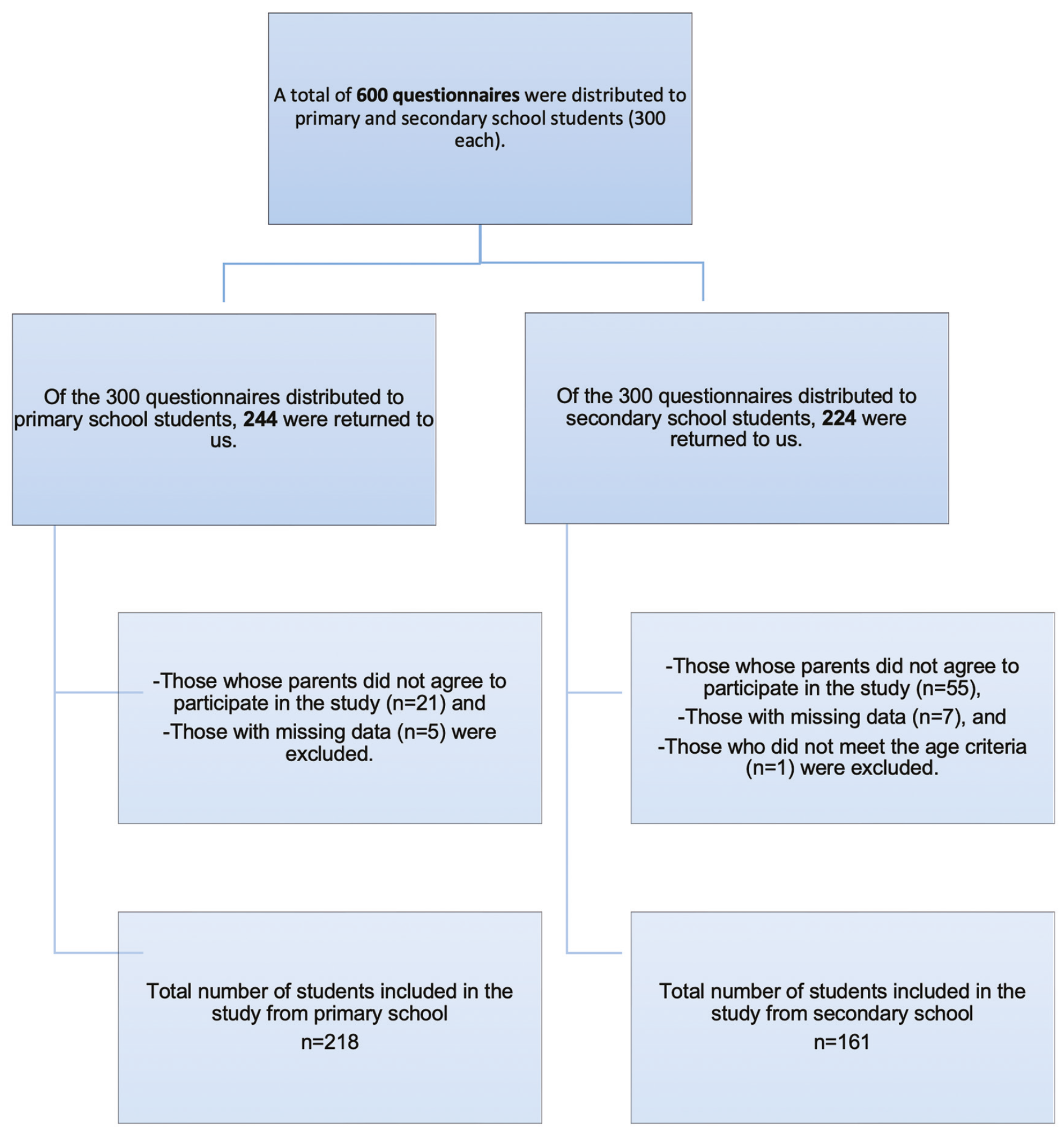
Ethics approval was obtained from the University of Health Sciences Türkiye, Gaziosmanpaşa Training and Research Hospital Ethics Committee (approval no: 398, date: 22.12.2021) and the İstanbul Governorship Provincial Directorate of National Education (24.02.2022, no: E-59090411). Parents were informed about the study objectives and procedures through written information sheets provided together with the questionnaires, and written informed consent was obtained prior to participation.
Data Collection Tools
Child and Parent Information Form
A structured form developed by the authors based on the relevant literature was used to collect data on sociodemographic characteristics (age, sex, grade level), early-life factors (maternal age at delivery, mode and timing of birth, birth weight, breastfeeding history, antibiotic use during the first year of life, respiratory disease before age two, history of hospitalization due to pneumonia), dietary habits (packaged/processed food consumption), and known medical conditions. Parental sociodemographic and medical characteristics, including age, educational level, household income, asthma/allergy history, chronic disease status, and smoking status, were also recorded.
School-based Asthma and Allergy Screening Questionnaire
The School-based Asthma and Allergy Screening Questionnaire (SBASQ) was developed by Redline et al. in 2004 to identify school-aged children who may be at increased risk for asthma and allergic conditions, particularly those who have not been previously diagnosed. The Turkish validity and reliability study was conducted by Kilic et al.. The SBASQ consists of two components: a parent/caregiver questionnaire (PQ) and a student questionnaire (SQ). The final four items in both components, which relate to physician diagnosis and medication use, are excluded from scoring, as they are not part of the symptom-based screening score. According to the scoring system, a total score of ≥3 indicates asthma-related screening positivity, while a score of ≥1 indicates allergy-related screening positivity. In the present study, these cut-off values were operationally interpreted as indicating positive screening results rather than clinical diagnosis. The Turkish version demonstrated acceptable internal consistency, with Cronbach’s alpha coefficients of 0.72 for the SQ and 0.80 for the PQ.
Study Procedure
Data collection was conducted between March 1 and April 5, 2022. Questionnaires were distributed to 600 students (300 primary school and 300 secondary school) via their teachers and completed at home by the children and their parents/caregivers. Of these, 468 questionnaires were returned (response rate: 78%). After excluding 76 cases due to parental non-consent and 13 cases with incomplete data or failure to meet age criteria, a total of 379 complete and eligible questionnaires were included in the final analysis ().
Statistical Analysis
All statistical analyses were conducted using IBM SPSS Statistics version 22. The distributional properties of continuous variables were evaluated using the Kolmogorov-Smirnov and Shapiro-Wilk tests. Continuous variables were summarized as mean ± standard deviation, whereas categorical variables were expressed as frequencies and percentages. Associations between categorical variables were examined using the chi-square test. Yates’ continuity correction was applied when appropriate, and Fisher’s exact test was used when expected cell counts were low. All analyses were two-sided, and a p-value <0.05 was considered statistically significant.
RESULTS
The study included 379 children aged 7-14 years, with a mean age of 10.09±1.97 years. The mean age of mothers was 36.9±5.5 years (range: 26-56), and the mean age of fathers was 41.3±5.2 years (range: 29-57). A physician-diagnosed history of asthma and/or allergy was reported in 89 children (23.5%). Among the 89 children (23.5%) with a physician-diagnosed respiratory/allergic condition, 70 (18.5%) had asthma (with or without allergy) and 56 (14.8%) had allergy (with or without asthma). The sociodemographic and clinical characteristics of the children and parents are summarized in and , respectively.
Table 1. Sociodemographic, clinical, and environmental characteristics of children
n | % | ||
|---|---|---|---|
Sociodemographic characteristics | |||
Gender | Female | 191 | 50.4 |
Male | 188 | 49.6 | |
Age (years) | 7-10 | 238 | 62.8 |
11-14 | 141 | 37.2 | |
Number of siblings | None | 28 | 7.4 |
1-3 | 289 | 76.2 | |
4 and above | 62 | 16.4 | |
Clinical characteristics | |||
Physician-diagnosed asthma and/or allergy | Yes | 89 | 23.5 |
No | 290 | 76.5 | |
Perinatal and early-life characteristics | |||
Mode of delivery | Vaginal delivery | 201 | 53.0 |
Cesarean section | 178 | 47.0 | |
Time of birth | Term | 326 | 86.0 |
Preterm | 34 | 9.0 | |
Postterm | 19 | 5.0 | |
Birth weight | Normal | 337 | 88.9 |
Low | 35 | 9.2 | |
High | 7 | 1.8 | |
Breastfeeding history | Yes | 366 | 96.6 |
No | 13 | 3.4 | |
Antibiotic use during the first year of life | Yes | 179 | 47.2 |
No | 200 | 52.8 | |
Respiratory tract disease before the age of two | Yes | 70 | 18.5 |
No | 309 | 81.5 | |
History of hospitalization due to pneumonia | Yes | 29 | 7.7 |
No | 350 | 92.3 | |
Packaged/processed food consumption | Never/almost never | 31 | 8.2 |
Rarely | 257 | 67.8 | |
Often | 91 | 24 | |
Household smoking exposure | Yes | 182 | 48.0 |
No | 197 | 52.0 |
Data presented as number (%) of participants
Table 2. Sociodemographic and clinical characteristics of parents
- | - | n | % |
|---|---|---|---|
Parental educational level | |||
Mother | Literate | 20 | 5.3 |
Primary school | 145 | 38.3 | |
Middle school | 95 | 25.1 | |
High school | 93 | 24.5 | |
University | 26 | 6.9 | |
Father | Literate | 10 | 2.6 |
Primary school | 141 | 37.2 | |
Middle school | 97 | 25.6 | |
High school | 103 | 27.2 | |
University | 28 | 7.4 | |
Parental smoking status | |||
Mother | Current smoker | 93 | 24.5 |
Former smoker | 22 | 5.8 | |
Never smoker | 264 | 69.7 | |
Father | Current smoker | 210 | 55.4 |
Former smoker | 57 | 15 | |
Never smoker | 112 | 29.6 | |
Parental asthma/allergy history | |||
Mother | Yes | 51 | 13.5 |
Father | Yes | 23 | 6.1 |
Household income level | Low | 123 | 32.5 |
Middle | 225 | 59.4 | |
High | 31 | 8.2 | |
Data presented as number (%) of participants
According to the PQ, 27.7% of the children screened positive for asthma-related symptoms, and 68.1% screened positive for allergy-related symptoms. Based on the SQ, 25.3% of the children screened positive for asthma-related symptoms, and 63.6% screened positive for allergy-related symptoms ().
Table 3. SBASQ score distribution and screening-positive results for asthma- and allergy-related symptoms
Distribution of SBASQ scores | Min-max | Mean ± SD (median) |
|---|---|---|
Asthma (PQ) | 0-8 | 1.8±2.1 (1) |
Allergy (PQ) | 0-2 | 0.9±0.7 (1) |
Asthma (SQ) | 0-7 | 1.6±1.8 (1) |
Allergy (SQ) | 0-2 | 0.8±0.7 (1) |
Screening-positive results based on SBASQ cut-off scores | n | % |
Asthma-related symptoms (PQ) | 105 | 27.7 |
Allergy-related symptoms (PQ) | 258 | 68.1 |
Asthma-related symptoms (SQ) | 96 | 25.3 |
Allergy-related symptoms (SQ) | 241 | 63.6 |
Data are presented as mean ± SD (median) and minimum-maximum values
Screening-positive results were defined according to SBASQ cut-off scores (≥3 for asthma-related symptoms and ≥1 for allergy-related symptoms)
PQ: Parent/caregiver questionnaire, SQ: Student questionnaire, SBASQ: School-Based Asthma and Allergy Screening Questionnaire, SD: Standard deviation
As shown in , children who had received antibiotics during the first year of life showed significantly higher positive screening rates for both asthma- and allergy-related symptoms according to both the PQ (34.1% and 73.2%, respectively; p=0.009 and p=0.043) and the SQ (30.2% and 71.5%, respectively; p=0.040 and p=0.002). Similarly, a history of respiratory disease before the age of two years was associated with markedly higher screening-positive rates in both the PQ (50.0% and 87.1%) and the SQ (44.3% and 82.9%) (p<0.001 for all comparisons). Positive screening for asthma-related symptoms based on the PQ was also more frequent among boys than girls (p=0.041).
Table 4. Distribution of screening-positive results for asthma- and allergy-related symptoms according to child characteristics
- | - | Asthma-related symptoms (PQ) | Allergy-related symptoms (PQ) | Asthma-related symptoms (SQ) | Allergy-related symptoms (SQ) |
|---|---|---|---|---|---|
- | - | n (%) | n (%) | n (%) | n (%) |
Sociodemographic characteristics | |||||
Gender | Female | 44 (23%) | 123 (64.4%) | 41 (21.5%) | 118 (61.8%) |
Male | 61 (32.4%) | 135 (71.8%) | 55 (29.3%) | 123 (65.4%) | |
1p | 0.041* | 0.122 | 0.081 | 0.461 | |
Age | 7-10 | 65 (27.3%) | 164 (68.9%) | 67 (28.2%) | 155 (65.1%) |
11-14 | 40 (28.4%) | 94 (66.7%) | 29 (20.6%) | 86 (61%) | |
1p | 0.824 | 0.651 | 0.101 | 0.419 | |
Perinatal and early-life characteristics | |||||
Mode of delivery | Vaginal | 59 (29.4%) | 134 (66.7%) | 51 (25.4%) | 126 (62.7%) |
C/S | 46 (25.8%) | 124 (69.7%) | 45 (25.3%) | 115 (64.6%) | |
1p | 0.446 | 0.532 | 0.984 | 0.698 | |
Time of birth | Term | 86 (26.4%) | 223 (68.4%) | 82 (25.2%) | 205 (62.9%) |
Preterm | 14 (41.2%) | 26 (76.5%) | 9 (26.5%) | 26 (76.5%) | |
Postterm | 5 (26.3%) | 9 (47.4%) | 5 (26.3%) | 10 (52.6%) | |
1p | 0.184 | 0.088 | 0.981 | 0.174 | |
Birth weight | Normal | 88 (26.1%) | 226 (67.1%) | 82 (24.3%) | 211 (62.6%) |
Low | 16 (45.7%) | 29 (82.9%) | 13 (37.1%) | 26 (74.3%) | |
High | 1 (14.3%) | 3 (42.9%) | 1 (14.3%) | 4 (57.1%) | |
3p | 0.035* | 0.057 | 0.201 | 0.369 | |
Breastfeeding history | Yes | 101 (27.6%) | 250 (68.3%) | 93 (25.4%) | 232 (63.4%) |
No | 4 (30.8%) | 8 (61.5%) | 3 (23.1%) | 9 (69.2%) | |
3p | 0.760 | 0.563 | 1.000 | 0.776 | |
Antibiotic use during the first year of life | Yes | 61 (34.1%) | 131 (73.2%) | 54 (30.2%) | 128 (71.5%) |
No | 44 (22.0%) | 127 (63.5%) | 42 (21.0%) | 113 (56.5%) | |
1p | 0.009* | 0.043* | 0.040* | 0.002* | |
Respiratory illness before the age of two | Yes | 35 (50%) | 61 (87.1%) | 31 (44.3%) | 58 (82.9%) |
No | 70 (22.7%) | 197 (63.8%) | 65 (21%) | 183 (59.2%) | |
1p | <0.001* | <0.001* | <0.001* | < 0.001* | |
History of hospitalization due to pneumonia | Yes | 14 (48.3%) | 20 (69%) | 10 (34.5%) | 20 (69%) |
No | 91 (26%) | 238 (68%) | 86 (24.6%) | 221 (63.1%) | |
2p | 0.018* | 1.000 | 0.338 | 0.671 | |
Packaged/processed food consumption | Never/almost never | 7 (22.6%) | 13 (41.9%) | 5 (16.1%) | 17 (54.8%) |
Rarely | 64 (24.9%) | 176 (68.5%) | 64 (24.9%) | 155 (60.3%) | |
Often | 34 (37.4%) | 69 (75.8%) | 27 (29.7%) | 69 (75.8%) | |
1p | 0.059 | 0.002* | 0.314 | 0.017* | |
Household smoking exposure | Yes | 50 (27.5%) | 127 (69.8%) | 47 (25.8%) | 122 (67.0%) |
No | 55 (27.9%) | 131 (66.5%) | 49 (24.9%) | 119 (60.4%) | |
1p | 0.923 | 0.493 | 0.832 | 0.180 | |
1Chi-square test, 2Yates’ continuity correction, 3Fisher’s exact test, *p<0.05
Data presented as number (%) of participants. C/S: Cesarean section, PQ: Parent/caregiver questionnaire, SQ: Student questionnaire
As presented in , maternal history of asthma or allergy was associated with significantly higher positive screening rates for allergy-related symptoms according to both the PQ (84.3%) and the SQ (78.4%) (p=0.012 and p=0.027, respectively). Paternal history of asthma or allergy was associated with higher positive screening rates for asthma-related symptoms according to the PQ (47.8%) and for both asthma-related (47.8%) and allergy-related (87.0%) symptoms according to the SQ (p=0.047, p=0.021, and p=0.029, respectively).
Table 5. Distribution of screening-positive results for asthma- and allergy-related symptoms according to parental sociodemographic and clinical characteristics
- | - | Asthma-related symptoms (PQ) | Allergy-related symptoms (PQ) | Asthma-related symptoms (SQ) | Allergy-related symptoms (SQ) |
|---|---|---|---|---|---|
n (%) | n (%) | n (%) | n (%) | ||
Maternal smoking status | Current smoker | 25 (26.9%) | 62 (66.7%) | 19 (20.4%) | 57 (61.3%) |
Former smoker | 5 (22.7%) | 15 (68.2%) | 7 (31.8%) | 18 (81.8%) | |
Never smoker | 75 (28.4%) | 181 (68.6%) | 70 (26.5%) | 166 (62.9%) | |
1p | 0.832 | 0.945 | 0.393 | 0.180 | |
Paternal smoking status | Current smoker | 62 (29.5%) | 146 (69.5%) | 57 (27.1%) | 137 (65.2%) |
Former smoker | 18 (31.6%) | 42 (73.7%) | 19 (33.3%) | 37 (64.9%) | |
Never smoker | 25 (22.3%) | 70 (62.5%) | 20 (17.9%) | 67 (59.8%) | |
1p | 0.302 | 0.269 | 0.061 | 0.614 | |
Maternal asthma/allergy history | No | 85 (25.9%) | 215 (65.5%) | 77 (23.5%) | 201 (61.3%) |
Yes | 20 (39.2%) | 43 (84.3%) | 19 (37.3%) | 40 (78.4%) | |
2p | 0.071 | 0.012* | 0.053 | 0.027* | |
Paternal asthma/allergy history | No | 94 (26.4%) | 238 (66.9%) | 85 (23.9%) | 221 (62.1%) |
Yes | 11 (47.8%) | 20 (87%) | 11 (47.8%) | 20 (87%) | |
2p | 0.047* | 0.076 | 0.021* | 0.029* | |
Household income level | Low | 41 (33.3%) | 82 (66.7%) | 39 (31.7%) | 78 (63.4%) |
Middle | 57 (25.3%) | 156 (69.3%) | 48 (21.3%) | 140 (62.2%) | |
High | 7 (22.6%) | 20 (64.5%) | 9 (29%) | 23 (74.2%) | |
1p | 0.225 | 0.796 | 0.092 | 0.430 |
1Chi-square test, 2Fisher’s exact test, *p<0.05, screening-positive results were defined according to SBASQ cut-off scores
PQ: Parent/caregiver questionnaire, SQ: Student questionnaire, SBASQ: School-Based Asthma and Allergy Screening Questionnaire
DISCUSSION
In this school-based cross-sectional screening study, 27.7% of children screened positive for asthma-related symptoms and 68.1% for allergy-related symptoms according to parent reports, with similar proportions observed in the student component. These rates exceeded the prevalence of physician-diagnosed asthma and/or allergy in the study population, reflecting the broader symptom burden captured by screening-based assessment. Screening-positive results were associated with male sex, early-life respiratory morbidity and antibiotic exposure, low birth weight, and parental history of asthma or allergy. Although screening positivity does not equate to clinical diagnosis, these findings highlight the presence of potentially unrecognized respiratory and allergic symptoms in school-age children and suggest a gap between symptom experience and formal diagnosis.
Large-scale international studies have consistently demonstrated wide cross-country variation in the prevalence of asthma symptoms and physician-diagnosed asthma, with rates differing markedly across regions and age groups-. National data from Türkiye similarly indicate considerable heterogeneity in asthma and allergic disease prevalence among school-age children, . Within this context, the proportion of physician-diagnosed asthma observed in the present study (18.5%) falls within previously reported ranges, whereas the higher screening-positive proportions are consistent with the broader symptom patterns typically identified through questionnaire-based assessment.
Discrepancies between symptom-based screening results and physician-diagnosed asthma have been reported in pediatric community populations, where questionnaire-based tools often identify children with unrecognized respiratory symptoms-. Such differences are often attributed to under-recognition and variability in healthcare access. In this context, school-based screening may be viewed as a complementary strategy that enhances early detection of symptom burden rather than as a measure of confirmed disease prevalence.
Early-life biological vulnerability and familial predisposition are well-established determinants of susceptibility to asthma- and allergy-related symptoms, . Longitudinal evidence demonstrates that early respiratory infections, antibiotic exposure in infancy, and perinatal factors contribute to later respiratory and allergic outcomes through mechanisms involving immune system maturation and lung development-. Parental asthma or allergy further amplifies this risk via both genetic susceptibility and shared environmental influences. In line with this evidence, our findings showed that early-life exposures—particularly respiratory illness in early childhood and antibiotic use during the first year of life—are associated with higher screening-positive rates for asthma- and allergy-related symptoms, together with established risk factors such as low birth weight and parental atopy. Collectively, these findings support the notion of a cumulative risk profile shaped by interacting biological and familial factors, which can be effectively captured through school-based symptom screening approaches.
Environmental and behavioral influences appear to further modulate these underlying vulnerabilities. Although passive smoke exposure has been widely associated with increased asthma risk, its effects vary across settings, and no significant associations were detected in this study, . Conversely, dietary patterns—particularly frequent consumption of packaged/processed foods—were associated with allergy-related screening positivity, underscoring the interplay between lifestyle-related exposures and inherent susceptibility. Together, these findings illustrate a multifactorial risk landscape in which biological, familial, and environmental factors converge to shape symptom burden in school-age children.
At a system level, school-based screening can address a critical gap by identifying children who experience symptoms yet remain outside routine clinical detection pathways. Integrating such screening outputs into family medicine follow-up could support earlier evaluation and more timely preventive interventions without replacing clinical diagnosis.
This study has notable strengths, including use of a validated screening instrument incorporating both parent- and student-reported components and a school-based design capturing community-level symptom burden. Inclusion of both child- and parent-level variables enabled multidimensional evaluation of screening-positive profiles.
Study Limitations
Several limitations should be acknowledged. First, the cross-sectional design precludes causal inference. Second, screening-positive results were based on questionnaire responses without clinical confirmation and should therefore be interpreted as reflecting symptom burden rather than diagnosed disease. Third, the study was conducted in a single school representing a middle socioeconomic level, which may limit the generalisability of the findings to populations with different socioeconomic, environmental, and healthcare-access characteristics, as socioeconomic status is a known determinant of asthma and allergic disease prevalence. In additon, the self-reported nature of early-life and household exposures may introduce under- or misreporting, particularly for socially sensitive variables such as smoking. Finally, as analyses were primarily unadjusted, residual confounding cannot be excluded; multivariate analyses are warranted in future studies.
CONCLUSION
In this school-based cross-sectional screening study, a substantial proportion of school-age children screened positive for asthma- and allergy-related symptoms, with rates appearing higher than those typically reported for physician-diagnosed disease. Positive screening results were associated with several child- and parent-level characteristics, including early-life exposures and family history. Although screening positivity does not constitute a clinical diagnosis, these findings highlight the potential value of school-based screening approaches in identifying children who may benefit from further clinical evaluation. Integration of such strategies with primary care and family medicine practices may enhance early recognition of symptom burden and support timely referral and preventive interventions.
Footnotes
Ethics
Ethics Committee Approval: Ethics approval was obtained from the University of Health Sciences Türkiye, Gaziosmanpaşa Training and Research Hospital Ethics Committee (approval no: 398, date: 22.12.2021) and the İstanbul Governorship Provincial Directorate of National Education (24.02.2022, no: E-59090411).
Informed Consent: Parents were informed about the study objectives and procedures through written information sheets provided together with the questionnaires, and written informed consent was obtained prior to participation.
Authorship Contributions
Concept: Z.Y.E., S.T.K., O.B., Design: Z.Y.E., S.T.K., O.B., Data Collection or Processing: Z.Y.E., S.T.K., Analysis or Interpretation: Z.Y.E., S.T.K., Literature Search: Z.Y.E., S.T.K., Writing: Z.Y.E., S.T.K., O.B.
Conflict of Interest: No conflict of interest was declared by the authors.
Financial Disclosure: The authors declared that this study received no financial support.
References
Breiteneder H, Peng YQ, Agache I, Diamant Z, Eiwegger T, Fokkens WJ, et al. Biomarkers for diagnosis and prediction of therapy responses in allergic diseases and asthma. Allergy. 202075:3039-68.
World Health Organization. Asthma. Available from: https://www.who.int/news-room/fact-sheets/detail/asthma
Asher MI, Rutter CE, Bissell K, Chiang CY, El Sony A, Ellwood E, et al. Worldwide trends in the burden of asthma symptoms in school-aged children: global asthma network phase I cross-sectional study. Lancet. 2021;398:1569-80.
Mazur M, Czarnobilska M, Dyga W, Czarnobilska E. Trends in the epidemiology of allergic diseases of the airways in children growing up in an urban agglomeration. J Clin Med. 2022;11:2188.
Testa D, DI Bari M, Nunziata M, Cristofaro G, Massaro G, Marcuccio G, et al. Allergic rhinitis and asthma assessment of risk factors in pediatric patients: a systematic review. Int J Pediatr Otorhinolaryngol. 2020;129:109759.
Jones CM, DeWalt DA, Huang IC. Impaired patient-reported outcomes predict poor school functioning and daytime sleepiness: the PROMIS pediatric asthma study. Acad Pediatr. 2017;17:850-4.
Hay R, Namey B, Ripper L, Bunk E, Elliott J. Analysis of school-based asthma screenings and need for care coordination in underserved urban communities. J Am Pharm Assoc (2003). 2023;63:S48-51.
Borkowski V, Piano MR, Maughan ED, Curry-Johnson S, Jeffery AD. School-based health providers’ approaches to social risk screening for pediatric asthma: a qualitative study. Pediatr Pulmonol. 2025;60:e71105.
Redline S, Gruchalla RS, Wolf RL, Yawn BP, Cartar L, Gan V, et al. Development and validation of school-based asthma and allergy screening questionnaires in a 4-city study. Ann Allergy Asthma Immunol. 2004;93:36-48.
Kilic M, Ede G, Uzuncakmak T. The reliability and validity of the Turkish version of the school-based asthma and allergy screening questionnaires. BMC Pediatr. 2021;21:348.
Mallol J, Crane J, von Mutius E, Odhiambo J, Keil U, Stewart A, et al. The International Study of Asthma and Allergies in Childhood (ISAAC) phase three: a global synthesis. Allergol Immunopathol (Madr). 2013;41:73-85.
Shin YH, Hwang J, Kwon R, Lee SW, Kim MS, et al. Global, regional, and national burden of allergic disorders and their risk factors in 204 countries and territories, from 1990 to 2019: a systematic analysis for the Global Burden of Disease Study 2019. Allergy. 2023;78:2232-54.
Castro-Rodriguez JA, Soto-Martínez ME, Rodriguez-Martinez CE, Mocelin HT, Fischer GB, Mallol J. Severe childhood asthma in low and middle-income countries. Paediatr Respir Rev. 2026;57:17-26.
Lv JJ, Kong XM, Zhao Y, Li XY, Guo ZL, Zhang YJ, et al. Global, regional and national epidemiology of allergic disorders in children from 1990 to 2019: findings from the Global Burden of Disease study 2019. BMJ Open. 2024;14:e080612.
Karadag SIK, Sariaydin B, Sariaydin A, Sancak R. Evolving trends in pediatric allergic diseases: a cross-sectional study over 20 years in the central black sea region of Turkey. Pediatr Allergy Immunol Pulmonol. 2024;37:74-80.
Yazar B, Meydanlioglu A. The prevalence and associated factors of asthma, allergic rhinitis, and eczema in Turkish children and adolescents. Pediatr Pulmonol. 2022;57:2491-501.
Crispin-Cruz D, Casas-Herrera A, Rojas-Báez C, Torres-Duque C, González-García M. Asthma underdiagnosis in children: a school-based screening in a low socioeconomic status population. Biomedica. 2025;45:277-85.
Eijkemans M, Mommers M, Thijs C. Comparison of parent reported physician diagnosed asthma and general practitioner registration. J Asthma. 2023;60:1121-9.
Santorelli G, Pembrey L, Wright J. Agreement between parent reported and clinical coding of asthma, eczema and allergic rhinitis: the multi-ethnic born in bradford cohort. Pediatr Allergy Immunol. 2025;36:e70166.
O’Connor GT, Lynch SV, Bloomberg GR, Kattan M, Wood RA, Gergen PJ, et al. Early-life home environment and risk of asthma among inner-city children. J Allergy Clin Immunol. 2018;141:1468-75.
Aktaş S, Say A. Possible risk factors associated with allergic diseases among perinatal and infancy period. JAREM. 2019;9:91-6.
Wang X, Zheng K, Zhang Q. Asthma identified as a major risk factor for recurrent respiratory tract infections in children: a meta-analysis of 29 studies. J Asthma. 2025;62:386-403.
Miligkos M, Oh J, Kwon R, Konstantinou GN, Kim S, Yon DK, et al. Epidemiology of asthma across the ages. Ann Allergy Asthma Immunol. 2025;134:376-84.e13.
Patrick DM, Sbihi H, Dai DLY, Al Mamun A, Rasali D, Rose C, et al. Decreasing antibiotic use, the gut microbiota, and asthma incidence in children: evidence from population-based and prospective cohort studies. Lancet Respir Med. 2020;8:1094-105.
Su YY, Chen CJ, Chen MH, Lin CC, Chan CK, Hsieh WS, et al. Atopic diseases in pediatric population: prematurity and small for gestational age. BMC Pediatr. 2025;26:50.
Rørholt Grefslie M, Håberg SE, Magnus MC, Omsland TK, Magnus P. Parental asthma and risk of offspring asthma from childhood to adolescence: a population-based cohort study. BMJ Open Respir Res. 2026;13:e003608.
Maciag MC, Yousuf A, Hauptman M. Impact of prenatal exposure to smoking on child health. Clin Obstet Gynecol. 2022;65:388-96.
Docherty R, Gill M, Shankar S, Turner S, Dick S. Update of a systematic review on associations between environmental exposures and asthma control and exacerbations in young children. BMJ Open. 2025;15:e091855.
Berni Canani R, Carucci L, Coppola S, D’Auria E, O’Mahony L, Roth-Walter F, et al. Ultra-processed foods, allergy outcomes and underlying mechanisms in children: an EAACI task force report. Pediatr Allergy Immunol. 2024;35:e14231.